
Japan’s main EV purchase subsidy is about to run dry, weeks ahead of plan. The Next Generation Vehicle Promotion Center (NeV), which runs the Clean Energy Vehicle (CEV) subsidy for the Ministry of Economy, Trade and Industry, said on Wednesday, Nov. 18 that the money will probably run out on Nov. 20, 24 or 25. Only about ¥10.7 billion (about $67 million) was left as of Nov. 17.
The fine print makes it tighter than those dates sound. Applications are first come, first served by the day they arrive at NeV, and once the budget is hit, the program closes as of the previous business day. So if the money runs out on Wednesday, Nov. 25, the last accepted applications are the ones that arrive on Tuesday, Nov. 24 (online filings by 5:15 PM). If it runs out on Friday, Nov. 20, Thursday, Nov. 19 becomes the last day. Monday, Nov. 23 is a national holiday, which squeezes things a little more.
Anything that arrives after the cutoff gets rejected, NeV’s notice says, no matter when the car was registered or when the envelope was mailed.
A schedule that kept moving up
The program was funded with about ¥110 billion (about $690 million) in the fiscal 2025 supplementary budget, and as recently as Oct. 9 NeV expected it to last until early-to-late December. On Nov. 11 that became late November to early December. On Nov. 17 NeV narrowed it to Nov. 20–30, with about ¥12.1 billion (about $76 million) left as of Nov. 16. A day later, the window shrank to three possible dates. About ¥1.4 billion went in a single day.
The reason is simple. People bought a lot of EVs. Sales of battery EVs in Japan, kei cars included, hit 14,644 in October, about 2.5 times the year before and a record for the month, the Nikkei reported, citing the two national dealer associations. We noted last week that Japan passed 100,000 EVs in a year for the first time.
Tesla Japan, for one, has been busy. It said on Nov. 17 that it had delivered its 60,000th car in Japan.
What’s at stake per car
The amounts are big enough to change the math on a purchase. Under the current table, the maximum is ¥1.3 million (about $8,160) for an EV, ¥850,000 (about $5,330) for a plug-in hybrid and ¥1.5 million (about $9,410) for a fuel-cell car. Some examples from NeV’s model-by-model list dated Nov. 17:
- Tesla Model 3 and Model Y (every trim on the list): ¥1,270,000 (about $7,970)
- Tesla Model S and Model X: ¥1,016,000 (about $6,370)
- Toyota bZ4X: ¥1,300,000 (about $8,160)
- Nissan Leaf: ¥1,290,000 (about $8,090)
- Nissan Sakura kei EV: ¥580,000 (about $3,640)
- BYD Atto 3, Dolphin and Seal: ¥150,000 (about $940)
Those figures were already due to shrink. On Oct. 21 METI said cars registered from Jan. 1, 2027 would get roughly 60% to 80% of today’s amounts so the money would stretch further. In NeV’s table, the Model 3 and Model Y would have dropped to ¥762,000 (about $4,780) and the Sakura to ¥458,000 (about $2,870). If the budget is gone by next week, that January tier won’t come from this pot at all.
What happens to everyone else
This is the part buyers with an order in the pipeline will care about. METI says next fiscal year’s subsidy is still “under consideration,” according to TBS, and NeV says nothing has been decided. It did point to a precedent. In fiscal 2018 the subsidy also ran out early and closed with applications that arrived by Dec. 17, 2018. The next year’s program covered cars registered from Jan. 1, 2019, which left cars registered between Dec. 18 and Dec. 31, plus earlier cars whose paperwork missed the cutoff, with nothing from either year.
NeV adds a trap for anyone trading in a car. A trade-in counts as part of payment, so you can’t apply until the old car has actually been handed over, and an application with only a planned hand-over date that falls after the cutoff will be turned down. Payment and registration both have to be finished before you file.
So if your car is already registered, file now, online if you can. If you’re waiting on a delivery date, ask the dealer exactly when registration and payment will happen, because a car registered a day late could cost more than a million yen. NeV says it will update the forecast every business day until the program closes, and Nikkan Jidosha Shimbun notes the ministry will keep revising it as applications come in.
The rush also lands right as new models arrive. Suzuki’s first kei EV, the e SKY, went on sale on Nov. 17, and our e SKY launch story assumed buyers had until Dec. 31 for the full amount. That assumption no longer holds.
The EVX Take
Running out of subsidy money because people bought too many EVs is a good problem, and Japan has rarely had it. But a stop-start subsidy is a blunt tool. Buyers who ordered in good faith are now racing a bureaucratic clock, and dealers will see orders pulled forward into this week and then a dip until the next program is announced. The models hit hardest by a gap are the big-ticket ones, the Tesla Model 3 and Model Y and the Toyota bZ4X, where ¥1.27 million to ¥1.3 million is real money on a car that costs ¥5 million or more. Kei EVs like the Sakura and e SKY lose less in absolute terms but are bought by more price-sensitive households. The quickest fix would be for METI to say early what the 2027 program looks like, so buyers aren’t left guessing through December.
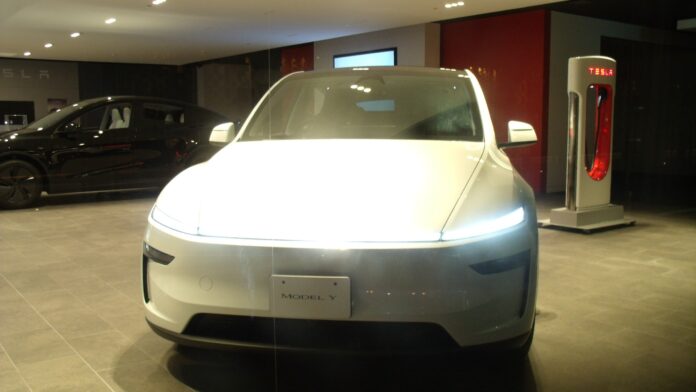
Sources: Next Generation Vehicle Promotion Center (NeV) notices of Nov. 17 and Nov. 18, 2026 and subsidy table dated Nov. 17; Tesla Japan on X; Nikkei; TBS News Dig; Nikkan Jidosha Shimbun. Featured image: a white Tesla Model Y in Tesla’s Shinsaibashi showroom in Osaka. Photo: Mr.ちゅらさん / Wikimedia Commons (CC BY 4.0), cropped.

