
Xpeng just had the biggest quarter in its history, and it’s promising a much bigger one. The Guangzhou EV maker reported third-quarter revenue of 24.28 billion yuan (about $3.6 billion) on Monday, Nov. 16, up 19.1% from a year earlier and 23.0% from the second quarter. For the October-to-December quarter, it expects to deliver 169,000 to 174,000 vehicles, which would be 45% to 50% more than a year ago.
The numbers come from Xpeng’s unaudited results, filed with the Hong Kong stock exchange on Monday. Management held its earnings call at 7:00 AM ET / 4:00 AM PT on Monday (9:00 PM JST Monday).
The quarter in numbers
Revenue landed above the top of Xpeng’s own range. In August, the company had guided for 21.7 billion to 23.4 billion yuan (about $3.3 billion to $3.5 billion), Sina Finance reported at the time. Deliveries hit a record 118,390, up 2.1% year over year and 14.6% from the second quarter, near the middle of its 115,000-to-121,000 guidance.
- Vehicle sales revenue: 21.63 billion yuan (about $3.2 billion), up 19.8%. Xpeng credits more deliveries and a richer model mix, which pushed up the average selling price.
- Vehicle margin: 13.1%, up from 12.1% in the second quarter and level with a year earlier.
- Overall gross margin: 18.9%, down from 20.7% in Q2. The drop came from services, where margins fell to 67.1% from 75.1% after a quarter with less revenue from technical R&D services.
- Net loss: 870 million yuan (about $130 million), narrower than Q2’s 1.34 billion yuan but wider than the 380 million yuan loss a year earlier.
- R&D spending: 2.85 billion yuan (about $430 million), up 17.5%, driven by new models and AI work.
- Cash and investments: 45.41 billion yuan (about $6.8 billion) at Sept. 30, up from 40.48 billion in June.
Xpeng also ended September with 731 stores in 253 Chinese cities and 4,035 company-run charging stations. The headline growth was confirmed in Chinese financial coverage on Monday, including The Paper (澎湃新闻) and D1EV (第一电动网).
The Q4 bet
The guidance is the real story. Xpeng delivered 50,237 cars in October, its first month above 50,000. To hit 169,000 to 174,000 for the quarter, it needs roughly 59,400 to 61,900 a month in November and December, our math says. That’s another step up in a market where price competition hasn’t eased. Revenue guidance is 30.4 billion to 31.8 billion yuan (about $4.6 billion to $4.8 billion), up 36.6% to 42.9% from a year earlier.
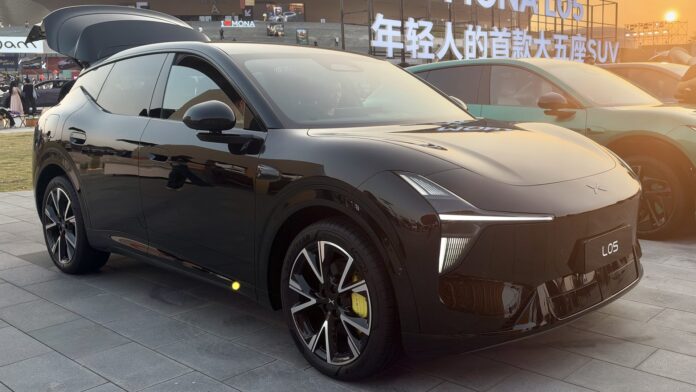
Most of the push rests on new metal. The Mona L05, a five-seat SUV under Xpeng’s budget Mona line, went on sale Oct. 29 and began nationwide deliveries in early November, CnEVPost and D1EV report. December is also China’s traditional year-end buying season.
Chairman and CEO He Xiaopeng framed it as the start of a run. “Our automotive business has entered a period of high growth driven by multiple hit products and global expansion,” he said in the release, adding that scale effects should get “better and better” over the next few quarters. Vice chairman and co-president Brian Gu pointed to the margin recovery: vehicle margin back to 13%, company margin near 19%.
The “physical AI” pitch
Xpeng now calls itself a “physical AI” company, and its CEO used the earnings release to push two non-car businesses. Its robotaxi unit received Guangzhou’s approval for citywide Level 4 demonstration operations on Oct. 26, and its next-generation humanoid robot is “accelerating” toward a year-end mass-production milestone, he said. That will sound familiar to Tesla shareholders. Tesla is also an EV company asking to be valued on autonomy and robots, with Optimus as its humanoid and a Robotaxi network already running in eight US cities.
The difference for now is scale and proof. Tesla’s driverless rides are open to the public in eight cities. Xpeng’s robotaxi is still at the invite-code stage, and its robot milestone is a promise for the next six weeks. The car business is paying for both, and this quarter it paid better than expected.
The EVX Take
Put the guidance next to Japan and it looks enormous. At the midpoint, Xpeng plans to deliver about 171,500 cars in three months. Japan’s entire battery-electric passenger market sold 111,876 cars from January through October, a record we reported this month. Xpeng’s October alone (50,237) was more than three times Japan’s October EV total of 14,644. Xpeng doesn’t sell cars in Japan, and nothing in this report suggests that’s changing soon. Still, this is the volume Japanese automakers are up against in China, and it’s why a second-tier Chinese brand can fund humanoid robots and robotaxis while still posting a net loss. If the Mona L05 carries Xpeng to 60,000 a month, the 2027 conversation will be about which right-hand-drive markets come next.
Sources: Xpeng unaudited Q3 2026 results (HKEX filing); The Paper (澎湃新闻); D1EV (第一电动网); Sina Finance; CnEVPost; 10jqka (同花顺). Featured image: XPeng Mona L05 at a launch-day display in China, Oct. 29, 2026. Photo: Poprace via Wikimedia Commons, CC0 (cropped). Exchange rate: about 6.67 yuan per dollar.

, beating guidance. It expects 169,000 to 174,000 Q4 deliveries, up at least 45%.)