
Toyota Motor Corporation’s operating income rose 9.2% to ¥2.1911 trillion (about $13.9 billion) in the first half of the fiscal year ending March 2027, and the company raised its full-year operating-income forecast to ¥3.9 trillion (about $24.7 billion). It was Toyota’s first year-over-year first-half operating-profit increase in three years.
The numbers come from Toyota’s Nov. 5 U.S. newsroom release and the FY2027 second-quarter presentation posted the same day (1:55 PM JST Nov. 5 / 11:55 PM ET Nov. 4 / 8:55 PM PT Nov. 4). Consolidated sales revenue hit ¥26.9624 trillion (about $171 billion), up 9.5%. Net income attributable to Toyota rose to ¥2.236 trillion (about $14.2 billion). Consolidated vehicle sales were about 4.758 million, down roughly 25,000 units from a year earlier. FX note for this article: about ¥158 per dollar on Nov. 6, 2026.
Guidance goes up
For the full year to March 31, 2027, Toyota now guides to:
- Consolidated vehicle sales: 9.70 million
- Net revenue: ¥53.5 trillion (about $339 billion)
- Operating income: ¥3.9 trillion (about $24.7 billion)
- Income before taxes: ¥4.96 trillion (about $31.4 billion)
- Net income: ¥3.57 trillion (about $22.6 billion)
The operating-income target is ¥500 billion higher than the previous forecast and ¥100 billion above last year, per the presentation. Toyota said it offset Middle East disruption, rising materials costs and production hits from earthquakes and floods with recovery work, better supply allocation, lower tariff-related costs and more value-chain profit. HEVs carried retail demand. Japanese-language coverage from TRANS CAR stressed the three-year gap since the last first-half operating-profit increase and noted that the full-year retail sales plan was trimmed even as the profit outlook rose.
Where the profit came from
Japan was the profit engine. Domestic vehicle sales rose by about 54,000 to roughly 1.024 million, and Japan operating income (ex valuation gains/losses on interest-rate swaps) climbed by ¥138.8 billion to ¥1.257 trillion. North America sold about 1.53 million vehicles, nearly flat, while operating income there recovered by ¥266.1 billion to ¥132.0 billion on the same basis. Europe and “other” regions also improved; Asia operating income dipped slightly. Financial services operating income rose to ¥472.3 billion including valuation items.
That split matters for the EV reading of the results. Toyota is still making most of its money on hybrids and conventional product while it scales BEVs. Japan’s October registered BEV tally already showed Toyota leading domestic battery-electric volume with the bZ4X. The H1 profit print does not break out BEV margin, but it does show the company can raise guidance while HEV demand stays strong — the multi-pathway bet in operating form.
Currency helped. Toyota’s presentation materials lean on a weaker yen versus last year’s first half, and the full-year guide assumes about ¥157 to the dollar. That is not the whole story — volume mix, value-chain earnings and tariff mitigation are in the bridge — but Japanese readers should read the ¥3.9 trillion figure with the FX assumption in view. A sharp yen rebound would eat some of the raise.
Markets already moved
Tokyo traders did not wait for this write-up. In Thursday’s session Toyota shares jumped about 16.7% after the guidance raise, a move we logged in Stock Watch for Nov. 5. The earnings release and the stock move are the same story told twice: first as accounting, then as a vote on whether ¥3.9 trillion is believable.
China remains the soft spot in the narrative. Toyota is still cleaning up China-market quality issues after recalling more than 121,000 bZ3X and bZ7 EVs there this week (our recall story), and Chinese NEV competition is not easing. Strong H1 profit in Japan and North America buys time. It does not fix the China EV product problem by itself.
The EVX Take
For Japanese buyers and suppliers, this is the reassuring version of Toyota: hybrids still print cash, Japan plants are busy, and management felt confident enough to lift the year. The EV question is whether that cash gets spent on battery-electric product that can actually win in China and Europe, or mostly on defending the HEV moat. October’s Japan BEV numbers say Toyota is finally showing up in the domestic battery-electric column. The H1 results say it can afford to keep going. The China recall pile says it still has to execute.
Sources: Toyota USA Newsroom (Nov. 5, 2026); Toyota FY2027 Q2 presentation (PDF); TRANS CAR. FX: ≈¥158/$ on Nov. 6, 2026.
— The EVX News team
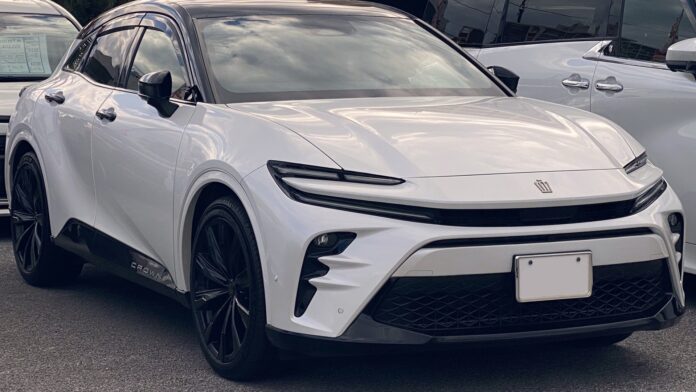
Featured image: Toyota Crown Sport Z (2024). Photo: Oq10pass / Wikimedia Commons (CC0, cropped and resized).

