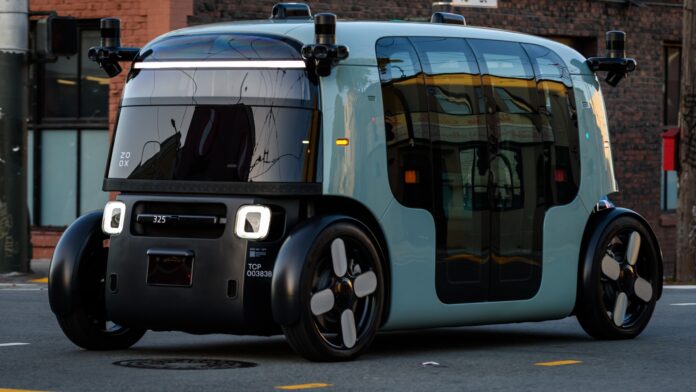

Amazon-owned Zoox plans to send data-collection vehicles to Europe and Asia, and CEO Aicha Evans put Japan and South Korea on the target list alongside London and other EU cities. She said it Wednesday, Nov. 4, at the WSJ Tech Live event. There is no public timeline for when those fleets leave the U.S., or when purpose-built Zoox robotaxis would follow.
The first step is not the toaster-shaped robotaxi Zoox is famous for. Evans said Zoox starts overseas the same way it starts in a new U.S. city: with sensor-equipped Toyota Highlander SUVs that map roads under a safety driver, then supervised autonomous testing, and only later the purpose-built vehicles that carry paying riders. Drive Tesla Canada, Reuters via TradingView and ServoSpace all carried the WSJ report. Zoox currently runs about 150 robotaxis in a handful of U.S. cities, including San Francisco and Las Vegas, Evans said.
Japan and Korea on a short list
Evans called London, other EU cities, Korea and Japan the “target list.” That is not a launch announcement. Zoox did not name Tokyo, Osaka, Seoul or any other city, and it did not say which regulator talks have started. In the U.S., Zoox’s own testing documentation describes a long pipeline: manual mapping, supervised driving with intervention logging, then the purpose-built cab. Public rides are not offered in the Highlanders.
Still, putting Japan in the same sentence as London matters. Japan already has Level 4 rules for set areas, is rewriting certification for vehicles without steering wheels (our MLIT story), and has Waymo lined up to test Toyota bZ4X-based robotaxis here in 2027. A second global robotaxi brand saying Japan is on the list raises the competitive temperature for Tesla, Tier IV, Turing and the taxi operators watching from the curb.
How Zoox stacks up against Tesla from Tokyo
Zoox’s product is a purpose-built, bidirectional pod with no steering wheel. Tesla’s Cybercab is also purpose-built and wheel-free, and Tesla is already carrying unsupervised riders in Texas and Florida Model Y Robotaxis while Cybercabs scale in Austin (fleet mix, Fort Worth). Zoox’s disclosed U.S. fleet of roughly 150 is a fraction of Tesla’s Texas registry alone. What Zoox has that Tesla does not is Amazon’s logistics map and a vehicle that was never sold as a consumer car.
The Highlander detail is a Japan twist of its own. Zoox’s data cars are Toyotas. If those SUVs eventually show up on Japanese roads for mapping, it will be a Toyota product collecting the miles that teach an Amazon robotaxi how to drive in Japan — while Toyota separately partners with Waymo. That is not a contradiction so much as a snapshot of how crowded Japan’s autonomy lane is getting.
One more constraint: Zoox has been expanding carefully inside the U.S. even while Tesla opens whole metro geofences. A Japan mapping fleet would put Zoox into a market where teleoperation bandwidth, local insurance partners and MLIT paperwork matter as much as the sensor stack. That favors companies that already have Japanese OEM or taxi-operator relationships. Zoox will need those relationships, or Amazon will have to buy them.
What to watch next
Three tells will separate a slide-deck ambition from a real program: an application or consultation with MLIT, photos of Highlanders with Zoox sensors on Japanese streets, and a named city. Until one of those appears, treat Evans’s list as intent. The WSJ appearance did exactly what these events are for — put Zoox on the global expansion board next to Waymo and Tesla without committing to a date that can slip.
The EVX Take
Japan does not need another press-conference robotaxi. It needs fleets that survive MLIT paperwork, insurance and local politics. Zoox naming Japan is still useful because it tells Tokyo that Amazon is watching the same regulatory window Tesla and Waymo are. For Japanese riders, the near-term experience will still be small Level 4 shuttles and, later, Waymo-Toyota tests. For Japanese suppliers, every new foreign entrant that needs maps, teleoperation centers and maintenance depots is a customer. The race is no longer “if Japan.” It is “who shows up with cars first.”
Sources: Drive Tesla Canada; Reuters / WSJ via TradingView; ServoSpace; Vector Wire. Primary remarks: Aicha Evans at WSJ Tech Live, Nov. 4, 2026.
— The EVX News team
Featured image: a Zoox autonomous robotaxi in San Francisco, May 2025. Photo: 9yz / Wikimedia Commons (CC BY 4.0, cropped and resized).

