
Tesla let Munro Live walk its Cybercab line in Texas, and the engineers did something they rarely do on camera: they graded their own homework. The Model Y’s structural battery pack got a “D.” The Cybercab pack got an “A minus.” And the new inverter built for the robotaxi is headed into the Model 3 this year.
The full deep dive went live on Monday, Oct. 26, and Tesla’s official Robotaxi account shared it at 1:25 PM ET / 10:25 AM PT (2:25 AM JST Tuesday):
A line that has to wait
The headline quote belongs to Lars Moravy, Tesla’s vice president of vehicle engineering. “We don’t run every day because the line can run so fast, it’s currently outpacing our deployments,” he said, adding that “right now, the manufacturing line’s ahead,” per TeslaNorth and Drive Tesla Canada. That lines up with Monday’s other news: Tesla stretched its Houston robotaxi zone about tenfold the same morning.
The speed comes from “unboxing,” the process Tesla first pitched in 2023. The car is built as front, rear, side and center modules that are assembled and tested separately, then joined. Because each module shows up pre-tested, final assembly takes just 25 stations. Engineers said a typical Model Y line has five to ten times that many. Other numbers from the tour:
- About 78% of the whole line is automated today, and the framing line is fully automated, down to the mobile robots delivering parts. The target is 100% automation at a 10-second cycle time.
- Floor space per vehicle is down about 50%.
- There’s no paint shop. Body panels get their color inside the molding machine, and the aluminum front and rear modules skip e-coating.
- The car is designed to run at least half a million miles.
Moravy said the team “hit a wall” about five or six years ago: “The problem wasn’t the automation, the problem was the design.” So they changed the design.
Grading the battery packs
The battery section is where it got candid. Tesla’s battery engineering director gave the Model Y structural pack a “D” for how hard and costly it was to build, the Cybertruck pack a “B minus,” and the Cybercab pack an “A minus,” Drive Tesla Canada reported. The Cybercab skips the fully structural approach. Its 88S6P pack of 4680 cells sits in a steel enclosure, with cells potted module by module, so a service crew can swap one failed module (he put one at about $1,500) instead of junking the whole pack. Replacing a pack before half a million miles “is a killer on cost,” he said.
Other details, via TeslaNorth: wireless battery management boards replace a wiring harness, and new interrupting contactors let Tesla drop the pyrotechnic fuse. The enclosure also leaves deliberate empty space for lower-density chemistries, with LFP named as the one Tesla wants as volume grows. A structural pack does fit about 10% more cells, the team said, but module-level repairs closed the gap on cost.
What reaches the Model 3
This is the part regular owners should care about. Nick Verzini, Tesla’s head of drive unit engineering, said the Cybercab’s new inverter power stage and circuit board, which use far fewer electronic components and can take parts from multiple suppliers, go into Model 3 production this year. He also confirmed the whole assembly could be dropped into a Model Y drive unit, but wouldn’t say whether that will happen, per Drive Tesla Canada. Tesla didn’t say which factories get it first. That matters here, since Japan’s Model 3s come from Shanghai.
The Cybercab’s own motor sits up front with an 11:1 gear ratio (most Teslas run about 9:1), because a city robotaxi doesn’t need a high top speed. A lubricant change later this year should cut gear-mesh losses by 7%. When Munro Live asked when it gets a Cybercab to tear down, Tesla’s answer was short: “Not yet.” The camera-feed fix riders asked for took two weeks. A teardown car will apparently take longer.
Sources: Munro Live on X (full video), Tesla Robotaxi on X, Sawyer Merritt on X, Drive Tesla Canada (2, 3, 4), TeslaNorth.
— The EVX News team
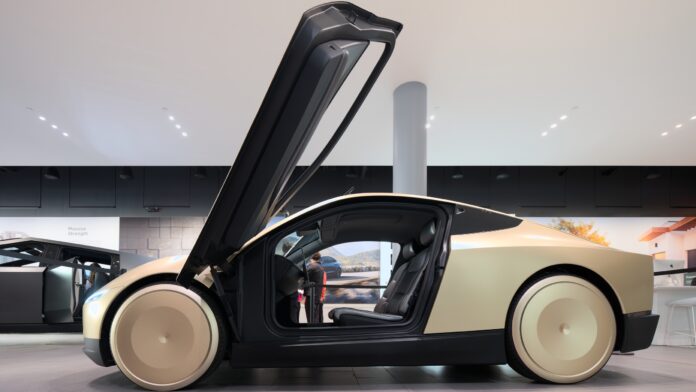
Featured image: Tesla Cybercab side view with its butterfly door open, at Santana Row in San Jose, California, November 2024. Photo: Dllu, via Wikimedia Commons, CC BY-SA 4.0 (cropped).

