
Toyota’s answer to Tesla FSD will run on Arene, the in-house software platform it is rolling out across its lineup, and it will come with a safety net Tesla doesn’t use: a rule-based “guardrail” that checks the AI’s driving and corrects it. Akihiro Sarada, who heads Toyota’s Digital Software Development Center, laid out the plan at the ITS World Congress in Gangneung, South Korea, this week, according to Impress Car Watch. The first cars arrive in 2028.
That 2028 date isn’t new. On Aug. 27, Toyota said it would launch a “Level 2++” automated driving system from 2028, with an end-to-end (E2E) AI that Toyota develops itself, as Car Watch, Reuters and Nikkei Asia reported at the time. What’s new is how it’s built, and that a few people have now ridden in it.
One AI, two layers
End-to-end means one neural network takes in what the cameras and sensors see and outputs the driving, rather than a stack of hand-written rules. Tesla made the switch with FSD v12, and it’s why FSD drives more like a person than it used to. Toyota is going the same way, with a twist.
Sarada said the driving AI is Toyota’s own and is what he called a foundation model, Car Watch reported. He didn’t describe its architecture, but said it draws on what Toyota has learned from the autonomy partners it works with around the world, naming Waymo and the Chinese firm Momenta. On top of it sits the guardrail, a rule-based system built on Toyota’s existing driver-assistance know-how. It checks the route the AI wants to take and, if something looks off, corrects it. Toyota said in August that the guardrail is also meant to explain what happened if the AI ever causes a crash.
He also explained what Toyota is not doing. Some developers, including Nvidia with its Alpamayo platform, use vision-language-action (VLA) models that put the driving reasoning into words. Sarada said that approach carries too heavy a load, and Toyota’s system will handle that exchange differently.
Why Arene matters here
Every piece of the E2E system will be developed on Arene, Sarada said: the Arene SDK, the Arene Data collection and analysis platform (key for gathering driving data), and Arene Tools for testing and validation. “In end-to-end software development, Arene leads to very efficient development,” he told reporters. The platform’s cost advantage, he explained, is that software built once can be reused with small changes.
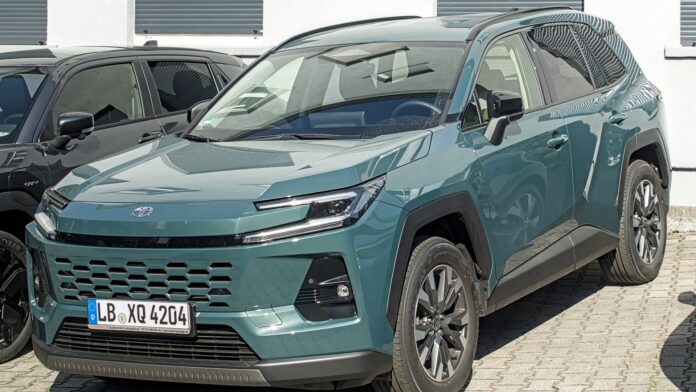
Arene already runs the driver-assistance and infotainment systems in the new RAV4, and Toyota plans to have about 50 models and more than 10 million vehicles a year on it in the early 2030s, which we covered when Toyota said every model goes software-defined by 2030. Toyota has also said the Level 2++ system will reach affordable cars. Car Watch speculates that the next-generation Corolla is the most likely first carrier, but Toyota hasn’t named a model.
A short ride in Europe
Car Watch got a brief ride in a development car at Toyota Motor Europe’s Technical Center, in a report published Oct. 19. It was the first time the test car’s exterior had been shown publicly. The ride stayed on the center’s private grounds, and the car, developed in Japan, had been adapted for Europe in a matter of days. It carried LiDAR along with cameras and radar. The staged incidents on the course were all handled, though nothing tested the guardrail. Car Watch’s verdict was polite. It drove smoothly, and the reporter would like to try it on real roads, the way Nissan has already offered rides in central Tokyo, including Ginza, in its Wayve-based next-generation ProPilot.
How it stacks up with Tesla
The comparison is hard to avoid. Tesla’s FSD (Supervised) runs end-to-end on cameras alone, without a rule-based layer second-guessing it. Tesla’s argument is that scale wins: more than 1.7 million paid FSD customers, and a driverless fleet that its Robotaxi safety report says has gone more than 3.1 million miles without an injury. Toyota is betting that a traditional automaker’s safety culture plus a rule-based backstop will win over regulators and buyers, especially in Japan. It’s also hedging on robotaxis, saying in August that it is considering a robotaxi business with Waymo, the company behind the driverless service now open to all in three more U.S. cities.
Level 2++ still means the driver watches the road. Toyota’s 2028 system is an advanced assistant, not a car that lets you nap. FSD still isn’t approved in Japan, so for Japanese buyers the first E2E car on sale here may well come from Nissan or Toyota. Tesla will have something to say about that, and so will Japan’s regulators.
Sources: Impress Car Watch (Oct. 21), Impress Car Watch (Oct. 19), Impress Car Watch (Aug. 27), Reuters Japan, Nikkei Asia, Tesla Q3 2026 earnings call transcript.
— The EVX News team
Featured image: The sixth-generation Toyota RAV4, the first Toyota built on the Arene software platform. Photo: Alexander Migl, Wikimedia Commons, CC BY-SA 4.0.

