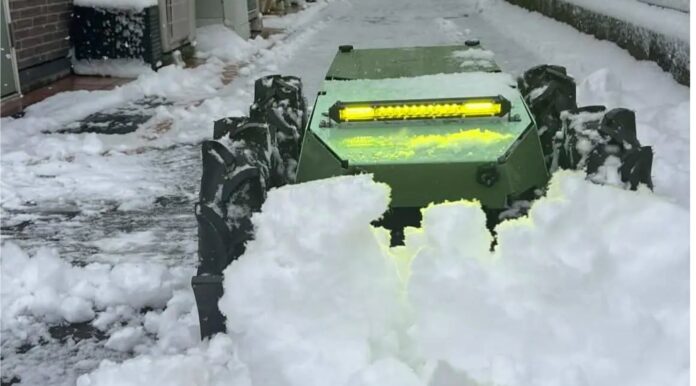

Japan’s snow country has a labor problem, and a Tokyo startup thinks the answer is a small electric robot. everblue Technologies’ “Snow Removal Drone” (除雪ドローン®) just won a CEATEC AWARD 2026, and its first self-driving model, the SRD-F11A, goes on sale in January 2027. The bigger goal: one person managing up to 10 of them.
From remote control to “supervise the robot”
Until now, everblue’s snow drone was a remote-control machine, a compact electric UGV (unmanned ground vehicle) with a plow blade that someone drives with a handheld controller. The 2027 model changes the job. According to everblue’s September announcement, the SRD-F11A follows preset routes or work areas on its own, while an operator watches within line of sight and can take over with the controller anytime.
- Positioning: RTK-GNSS, accurate to about 1 cm, with NTRIP network correction anywhere there’s mobile coverage.
- Brains: an automation unit called ebNavigator with dual GNSS antennas, plus a LiDAR sensor.
- App: an Android app, ebConnect, for setting work areas and routes and checking position and vehicle status. Mark an area, and the app can generate a route that covers the whole thing.
- Availability: reservations opened September 25. Sales start around January 2027 through authorized dealers or as a rental, for businesses, municipalities, road operators, airports and facility managers. No price yet, and the remote-control model stays on sale.
The design choice is the interesting part. everblue says it deliberately skipped camera-based autonomy, because blizzards and glare off the snow can confuse cameras and sensors. Instead, it pairs precise satellite positioning with a human checking safety by eye. That’s a practical approach for a machine that plows the same lot or path again and again.
Eight years to become “sellable”
At the show, CEO Tsuneki Noma told tech writer Masaki Ishitani (Yahoo! News Japan) that the company has been working on the autonomy for about eight years. What’s new is that it can finally be mass-produced. The key change is that both GNSS antennas now sit on a single board connected to the controller by one wire, instead of separate parts. The robot also doesn’t use a magnetic compass, which ground vehicles struggle with because of interference from the ground and nearby metal. It works out its heading from the two antennas, to within 1 degree.
Setup used to be a pain too. Noma said reporters sometimes had to wait about three hours while the machine was brought in, assembled and tuned. The RC model now boots in about 5 seconds, and the automation unit starts in under a minute. When the snow is falling at 6 a.m., that matters.
The award, and the swarm
The snow drone took the Mobility Innovation Award at CEATEC AWARD 2026, and according to Car Watch it was the only winner in the mobility category. It was shown at Japan Mobility Show Bizweek 2026, held with CEATEC at Makuhari Messe from October 13 to 16. Noma told Car Watch the company added autonomy because so many customers asked for it.
everblue also demoed ebSwarm, a fleet management system that lets one operator monitor and direct 2 to 10 robots from a single screen. Rather than building bigger machines, the strategy is to cover more ground with lots of small ones. Real-world testing at snow-removal sites is planned for the 2026-27 winter. Further out, the roadmap goes to “Swarm AI,” where AI plans and divides the work across 11 to hundreds of units, and “Physical AI,” where the robots sense the real world and work on their own. Both are still future concepts. The company also announced a powered blade that raises and lowers, so the same base can push dirt and level ground, not just snow.
The EVX News take
This is robotics as a tool, not as a show. Japan’s snowy regions are aging and losing people fast, and the hard part of shoveling isn’t intelligence, it’s labor. everblue’s choice of GPS precision plus human supervision over flashy computer vision is honest about what works in a blizzard today, and it’s a stepping stone to the full autonomy Musk keeps saying is coming for Optimus. The test of ebSwarm will be this winter. If one person really can run ten of these, snow clearing in Hokkaido could look very different.
Sources: everblue Technologies (Sept. 24), everblue Technologies (Oct. 8), everblue Technologies (Oct. 13), Car Watch, Yahoo! News Japan (Masaki Ishitani).
— The EVX News team
Featured image: Image: everblue Technologies via PR TIMES (press image).

