
If you talk to Grok in your Tesla, this one’s for you. SpaceXSI, the company behind Grok, has launched Grok Voice 3.0, which it calls “the world’s most intelligent speech-to-speech model.” The bold claims come with independent benchmarks, and the model is already handling millions of conversations a day in Tesla vehicles and Starlink’s call centers.
What’s new
Grok Voice 3.0 is a speech-to-speech model. Instead of converting your voice to text, thinking, and reading an answer back, it listens and responds in audio directly. That’s what makes a voice assistant feel like a conversation rather than a phone menu. According to SpaceXSI’s announcement, it responds in under a second, and it’s priced to undercut the competition.
The headline numbers, as SpaceXSI reports them from independent benchmarks:
- #1 on the Speech-to-Speech Index with a score of 86.9. The index combines speech reasoning, a customer-support benchmark called τ-Voice, and results from blind head-to-head calls.
- 97% on Full Duplex Bench, which measures how naturally a model handles pauses, turn-taking and interruptions. In other words, it knows when to stop talking.
- 71.6% on τ-Voice, which throws accents, background noise and interruptions at support agents. That’s a big jump from Grok Voice 2.0’s 56.5% and comparable to OpenAI’s GPT-Live-1, but at 40% lower latency.
- 74% on EVA-Bench, ServiceNow’s benchmark for enterprise voice agents, the highest accuracy score on that test.
- Cheaper per task: about $0.025 per task on Artificial Analysis’s Big Bench Audio run, versus $0.030 for GPT-Live-1 and $0.055 for GPT-Realtime-2.1.
Not every chart has Grok on top. GPT-Live-1 scored slightly higher in one agent success comparison in SpaceXSI’s own chart. But Grok gets close while answering noticeably faster and costing less, and that’s the trade-off that matters for anything talking to customers in real time.
Already working in your car
The most interesting part of the launch is that this isn’t a lab demo. SpaceXSI says Grok Voice 3.0 handles millions of conversations a day in Tesla vehicles. Owners can use Connectors for quick tasks like checking a calendar or answering an email, and hand bigger jobs, like ordering a coffee or booking dinner, to Grok Bot, whose voice mode also runs on the new model.
That builds on the Grok Bot integration Tesla rolled out in September, when owners started placing orders entirely by voice while FSD (Supervised) did the driving. Drive Tesla Canada highlighted a Vancouver owner who ordered Starbucks on the way without touching a phone.
A note on availability: Tesla North points out that SpaceXSI hasn’t said whether every Tesla with Grok is already on the new model or whether some owners need a software update first. For reference, the most recent in-car voice engine named in Tesla’s release notes, per Not a Tesla App, was Grok Voice Think Fast 2.0. Per Tesla’s support page, Grok needs an AMD-powered vehicle on software 2025.26 or later with Premium Connectivity or Wi-Fi. Connectors and Grok Bot need software 2026.26 or later and a Grok account, and Grok Bot also requires a SuperGrok subscription.
Starlink’s support line runs on it too
The other proof point comes from SpaceX’s own business. Starlink’s call centers use Grok Voice to answer about 20,000 customer calls a day in multiple languages. SpaceXSI says roughly 70% are resolved with no human involved, and one in four sales calls ends in a purchase before the caller hangs up. A single agent built on the model can verify a customer, troubleshoot hardware, issue credits and ship replacement equipment.
Anyone who’s spent 40 minutes on hold for a router reset can see the appeal.
For developers
Grok Voice 3.0 is available now in the Voice Agent API at $0.08 per minute ($4.80 an hour), the same price as Grok Voice 2.0. According to SpaceXSI’s developer release notes, apps using the grok-voice-latest alias were upgraded automatically with no code changes, and grok-voice-2.0 is now deprecated.
Why it matters
Voice is where AI stops being a website and becomes part of everyday life, in the car, on the phone, in a call center. Musk’s companies have a rare advantage here: millions of Teslas and a Starlink customer base that put the model to work at scale every day. That loop, real usage feeding a better model that then ships back to the same products, is hard for rivals without their own fleets to copy.
The EVX News take
Ignore the “world’s best” marketing language for a moment and look at the numbers: faster, cheaper, close to or ahead of the competition on accuracy, and already deployed to millions of people. That’s a strong launch. The next test is the one every Tesla owner can run: say “Hey Grok” and see whether the conversation feels more natural on your next drive.
Sources: SpaceXSI (Grok Voice 3.0 announcement), SpaceXSI developer release notes, Tesla North, Drive Tesla Canada, Not a Tesla App, Tesla Support.
— The EVX News team
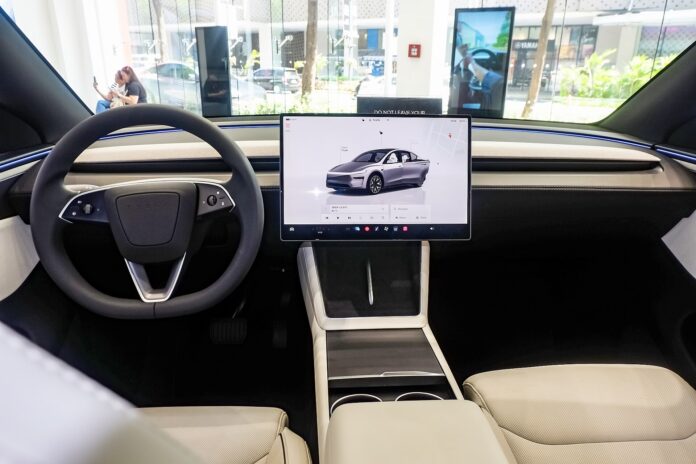
Featured image: Tesla Model Y L interior, by Ethan Llamas, via Wikimedia Commons, licensed under CC BY-SA 4.0.

