

Last week I talked about anti-Tesla vibes. This week, I wanted numbers instead of vibes.
So we counted headlines. A lot of headlines. 1,399 of them, from 15 news sites, over one full year. My eyes still hurt.
First, where we stand
Let’s be upfront. EVX News is openly a pro-Tesla site. You probably figured that out from the name of this column.
But we try hard to stay neutral in our news. We double-check every story against multiple sources. And we stay out of politics.
So take this column with that in mind. That’s also why we scored a pro-Tesla site the same way as everyone else. More on that below.
This is not a scientific study
Really. It’s not.
We read headlines only, not the full articles. Each headline was read and sorted by hand. We think headlines are a fair barometer of what a story is about. They’re also what most people see when they scroll. But a headline isn’t the whole story.
How we sorted every headline
The four buckets
- Negative framing: the writer adds spin. Snark, loaded words, or opinion dressed up as fact. Example: “The Tesla Roadster could have stayed vaporware.”
- Bad news: a real negative event, reported straight. A crash, a recall, a lawsuit, a probe, a sales drop. Example: “Tesla recalls nearly 3m vehicles in China over door handle safety risks.” We do not count this as bias. Bad news is news.
- Positive: a win. A launch, a record, a milestone, praise. Example: “Tesla Reaches Its Biggest Manufacturing Milestone Yet With 10 Million EVs.”
- Neutral: just the facts, no spin. Example: “Tesla and SpaceX have set up committees to explore a merger.”
We pulled the headlines from Google News, site by site. For the full year (Nov 2025 to Oct 2026), we grabbed a random 8 Tesla or Musk headlines per site, per month. Headlines that weren’t really about Tesla, Musk or his companies got tossed.
The one-year numbers
Sorted by negative framing, highest first.
| Outlet | Headlines | Negative framing | Bad news | Positive | Neutral |
|---|---|---|---|---|---|
| Futurism | 93 | 63% | 27% | 0% | 10% |
| Electrek | 91 | 38% | 22% | 20% | 20% |
| Gizmodo | 87 | 33% | 22% | 2% | 43% |
| The Guardian | 90 | 32% | 29% | 4% | 34% |
| Jalopnik | 81 | 32% | 23% | 12% | 32% |
| The Verge | 85 | 31% | 22% | 9% | 38% |
| Washington Post | 71 | 27% | 25% | 15% | 32% |
| New York Times | 91 | 25% | 16% | 12% | 46% |
| CNN | 76 | 13% | 22% | 14% | 50% |
| Business Insider | 91 | 11% | 10% | 16% | 63% |
| Bloomberg | 96 | 10% | 19% | 20% | 51% |
| InsideEVs | 91 | 10% | 14% | 30% | 46% |
| CNBC | 88 | 8% | 25% | 16% | 51% |
| Reuters | 95 | 6% | 22% | 22% | 49% |
| Teslarati (pro-Tesla check) | 89 | 1% | 2% | 64% | 33% |
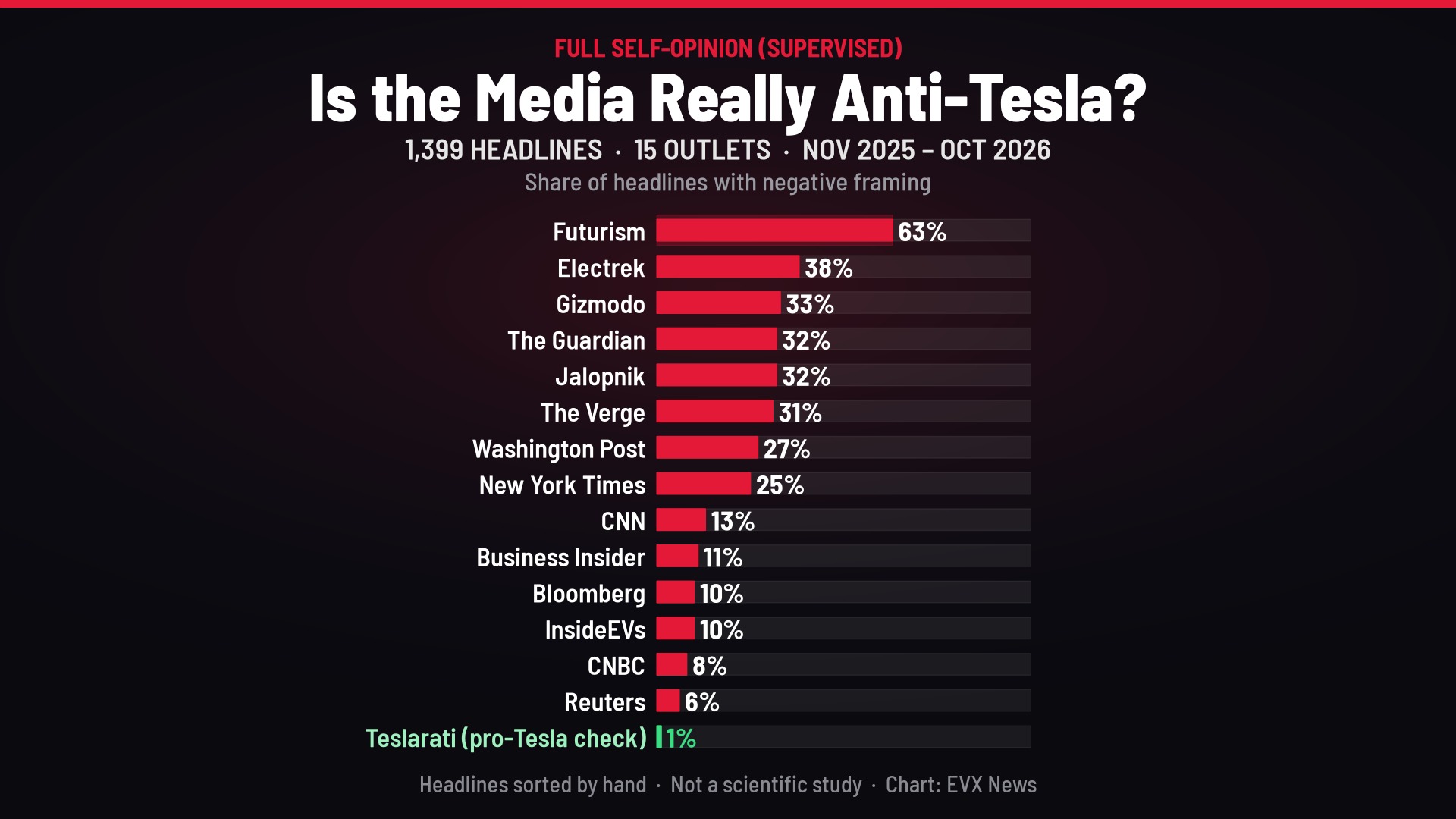
With about 70 to 96 headlines per site, each number can be off by roughly 10 to 12 points either way.
Why Teslarati is in there: it’s a pro-Tesla site, like us. If our sorting were rigged, it would show up here. Teslarati came out at 1% negative framing and 64% positive. So the method does tell sites apart, in both directions.
We also ran a one-month check (Oct 3 to Nov 3, 2026, up to 50 headlines per site). The order was almost the same. Futurism was again on top at 68% negative framing, and Reuters and CNBC were again at the bottom, at 2%. With smaller samples, those numbers can be off by about 14 to 23 points.
What they say about themselves
A few of these outlets have public promises about fairness. Here they are, right next to their numbers.
- Reuters promises “integrity, independence, and freedom from bias” and “unbiased and reliable news services” (Reuters Trust Principles). Negative framing in our sample: 6% for the year.
- The New York Times says it seeks the truth “without fear or favor” (Ethical Journalism handbook). Negative framing: 25%.
- The Washington Post says its reporters and editors “are committed to fairness” (Policies and Standards). Negative framing: 27%.
- Electrek’s editor wrote in 2024: “At Electrek, we like to be clear about our biases rather than claim we have none.” (Electrek, Sep 2024) No claim of being unbiased there. Negative framing: 38%.
For outside opinions, here’s how the bias-rating groups grade some of them. AllSides rates Reuters and Bloomberg as Center. It rates CNBC, CNN and the Washington Post as Lean Left, and The Guardian as Left. Ad Fontes says The Verge “Skews Left.” Media Bias/Fact Check rates Electrek, The Verge and Jalopnik as Left-Center.
The big caveat: a lot of it isn’t about cars
When we tagged each headline by topic, something jumped out. At the big newspapers, most Musk headlines aren’t about Tesla at all. They’re about SpaceX, Grok, X, DOGE, elections and court cases.
So here’s the same scoring, Tesla stories only.
| Outlet | Tesla headlines | Negative framing | Bad news | Positive |
|---|---|---|---|---|
| Futurism | 26 | 62% | 38% | 0% |
| Electrek | 89 | 38% | 22% | 20% |
| Jalopnik | 72 | 32% | 25% | 12% |
| Gizmodo | 20 | 20% | 35% | 5% |
| The Verge | 31 | 19% | 32% | 16% |
| Washington Post | 12 | 17% | 42% | 25% |
| Bloomberg | 28 | 14% | 36% | 25% |
| CNBC | 31 | 10% | 32% | 16% |
| InsideEVs | 91 | 10% | 14% | 30% |
| New York Times | 11 | 9% | 36% | 27% |
| The Guardian | 13 | 8% | 62% | 8% |
| CNN | 14 | 7% | 21% | 14% |
| Reuters | 41 | 5% | 32% | 39% |
| Business Insider | 31 | 3% | 19% | 26% |
| Teslarati (check) | 62 | 2% | 3% | 68% |
Some of these Tesla-only samples are tiny, as few as 11 headlines. Those numbers can be off by more than 25 points. Treat them as a hint, not a verdict.
So is it anti-Tesla, or anti-Musk?
This is the question I really wanted answered. Do the media go after Tesla? Or do they go after Musk, and Tesla just gets caught in the splash?
Here’s the negative framing (spin) rate for each type of headline, from the same one-year sample. Counts are spin headlines out of total headlines.
| Outlet | Tesla products | Other Musk companies (SpaceX, xAI/Grok, X…) | Musk politics/personal (no tech) |
|---|---|---|---|
| All 15 sites | 19% (108 of 572) | 18% (93 of 524) | 56% (88 of 156) |
| Futurism | 62% (16 of 26) | 57% (26 of 46) | 88% (15 of 17) |
| Gizmodo | 20% (4 of 20) | 33% (16 of 49) | 80% (8 of 10) |
| The Verge | 19% (6 of 31) | 27% (12 of 44) | 88% (7 of 8) |
| Business Insider | 3% (1 of 31) | 7% (3 of 41) | 50% (6 of 12) |
| New York Times | 9% (1 of 11) | 11% (5 of 47) | 55% (16 of 29) |
| The Guardian | 8% (1 of 13) | 24% (10 of 41) | 63% (17 of 27) |
| Washington Post | 17% (2 of 12) | 16% (5 of 32) | 50% (9 of 18) |
| CNN | 7% (1 of 14) | 3% (1 of 37) | 36% (8 of 22) |
| Electrek | 38% (34 of 89) | — (1 headline) | — (none) |
| Jalopnik | 32% (23 of 72) | 20% (1 of 5) | 67% (2 of 3) |
| Reuters, Bloomberg, CNBC | 7% (9 of 100) | 9% (14 of 156) | 0% (0 of 9) |
A few things the numbers show:
- Across all 15 sites, headlines about Musk’s politics or personal life were spun about three times as often as Tesla headlines. That’s 56% vs 19%.
- At the big newspapers (NYT, Guardian, WaPo, CNN), Tesla headlines were mostly straight. The spin showed up in the Musk politics and personal headlines.
- Electrek and Jalopnik are different. Almost everything they ran in our sample was about Tesla, and the spin was in the Tesla headlines themselves.
- Futurism was high on everything.
How often did a Tesla headline tie the company to Musk’s politics directly? Not often in our sample. We found 4 out of 572 Tesla headlines:
- “Tesla lost $15 billion in brand value in 2025 as Musk stepped deeper into politics, research shows” (CNBC, bad news)
- “‘I Bought This Before Elon Went Crazy’ Bumper Stickers Won’t Work on the New $60,000 Cybertruck” (Gizmodo, negative framing)
- “Tesla’s European Registrations Are Way Up Thanks To Evidently Short Memories” (Jalopnik, negative framing)
- “In Europe, Tesla Sales Are Rising Despite Views on Elon Musk” (New York Times, positive)
Small-sample warning: many of these cells are tiny. The big papers have only 11 to 14 Tesla headlines each, and some politics cells have fewer than 10. Those can easily be off by 25 points or more. The “all 15 sites” row is the most solid, at about ±4 to 8 points.
Side note: tech sites and Musk politics
My question was simple. Do tech sites cover Musk’s politics even when there’s no tech angle?
Some do. Here’s the share of each site’s Musk and Tesla headlines that were pure politics or personal life, with no tech in them, and how many of those were negative:
- Futurism: 18% (17 headlines), 94% of them negative
- Business Insider: 13% (12), 50% negative
- Gizmodo: 11% (10), 80% negative
- The Verge: 9% (8), 100% negative
- Jalopnik: 4% (3)
- Electrek, InsideEVs: 0%
- Teslarati: 1%
For comparison, the New York Times was at 32%, The Guardian 30%, CNN 29% and the Washington Post 25%. Reuters, CNBC and Bloomberg were at 1 to 5%.
A few examples, word for word: “A Huge Number of People Starved to Death After Elon Musk Cut USAID’s Funding” (Futurism). “Trump Lovingly Pats Elon Musk on Stomach During Dinner at White House” (Gizmodo). “Shocker: Elon Musk spends a lot of time on X posting bad political takes” (The Verge).
Fred Lambert on X
Electrek’s own headlines in our sample had zero pure-politics stories. Its editor’s X account is a different story.
We sorted 105 of Fred Lambert’s posts about Tesla or Musk from across the year, after removing 2 duplicates. 85 were negative (81%), 3 were positive and 17 were neutral. About 28 of them were about politics or Musk’s personal life, with no tech angle. All of those were negative.
For context: in 2020, Business Insider reported that Lambert said about 95% of his roughly 6,000 Tesla articles had been positive. In September 2024, he wrote that he had sold all his Tesla shares and no longer trusted Musk. Electrek’s About page says some of its writers hold long positions in TSLA and other green-energy stocks.
People have counted before
We’re not the first to do this.
- CleanTechnica (2018) tracked one week of Tesla headlines from 30+ big outlets. 155 of 208 were negative and 26 were positive (CleanTechnica).
- Weblyzard (2019) found about 53% negative and 8% positive in two months of Tesla news coverage (report PDF).
- The Media Research Center (2025), a conservative media watchdog, found network evening news coverage of Musk was 96% negative from January to April 2025 (as reported by Teslarati).
A few honest limits
- One person sorted the headlines. Nobody double-checked the sorting.
- Google News doesn’t show every story a site publishes. It’s a sample.
- This was a rough year with plenty of real bad news: fatal crashes, recalls, falling sales, the Grok image scandal. We counted those as bad news, not spin.
- Headlines only. A snarky headline can sit on top of a fair article, and the other way around.
If you want to check our work, the full list of headlines and how we sorted each one is available on request.
The EVX Take
The numbers show a wide spread. Reuters and CNBC sit near the pro-Tesla check site on spin. Futurism sits at the far end. In our sample, spin was about three times more common in Musk politics headlines than in Tesla headlines, and the big papers’ Tesla coverage was mostly straight. That matters in Japan too. A lot of Tesla news here starts as English headlines that get translated and shared, so the outlet a story came from shapes the first impression. Check the source, then read past the headline.