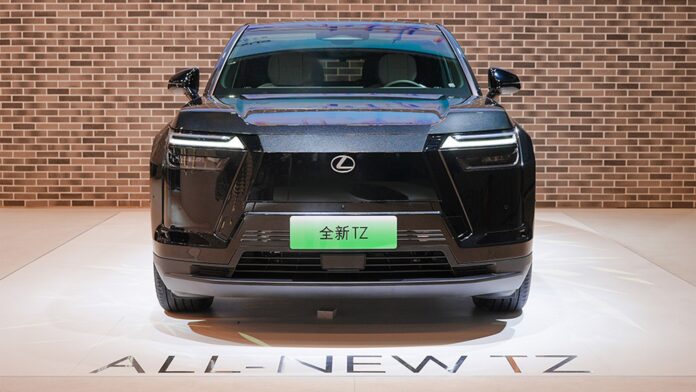

The Guangzhou Auto Show opened on Friday with Japan’s biggest carmakers all leaning on the same idea: build cars for China with Chinese technology. Lexus gave its first three-row EV, the TZ, its China debut. GAC Toyota named Toyota’s first-ever range-extender model and said it will use Huawei driver-assist software and a CATL battery. Dongfeng Nissan launched a plug-in hybrid SUV at 129,900 yuan (about $19,500). And one day earlier, Japanese media reported that Nissan wants to start shipping China-built plug-in hybrids to Japan.
The show runs Nov. 27 to Dec. 6 at the Canton Fair Complex with 1,106 vehicles, 115 of them debuts and 707 of them new-energy vehicles, according to the organizers via CnEVPost and Gasgoo. Tesla isn’t exhibiting, which is normal. BitAuto notes it has skipped major Chinese shows for several years and sells through its own stores and online instead.
Lexus TZ: China first, Japan “around winter”
The TZ is a 5.1-meter, three-row, six- or seven-seat electric SUV first revealed in May. In Guangzhou, Lexus China said it will go on sale in China in the first quarter of 2027. The China specs, reported by Gasgoo, IT Home and ifeng Auto: two 167 kW motors for 300 kW combined, 0 to 100 km/h in 5.4 seconds, a 95.82 kWh battery and 640 km on China’s CLTC test cycle, which is more generous than the WLTC figures used in Japan. Like the RZ550e we covered earlier this month, it has Interactive Manual Drive, Lexus’s simulated gearshift, here with a V10 sound effect.
Japan gets it soon. When it revealed the car in May, Toyota said the TZ would go on sale in Japan “around winter 2026.” Lexus China also said a first China-only EV, developed locally at its Shanghai plant, is coming in 2027.
Toyota’s first range-extender is a Highlander, and it’s built on Chinese tech
GAC Toyota used its press event to name the fifth-generation Highlander the Highlander 9X. It’s Toyota’s first range-extended EV anywhere, meaning an electric car whose gas engine works only as a generator to recharge the battery, according to the company as reported by National Business Daily, Yangtse Evening Post’s Ziniu News and IT Home. It will be unveiled globally in the first quarter of 2027 with Huawei’s driver-assist and cockpit software and a battery co-developed with CATL. GAC Toyota plans five new models in 2027: two new range-extenders, two refreshed EVs and one new-generation hybrid.
National Business Daily makes the bigger point. In April 2025 Toyota set up a “China ONE R&D” system that moved decisions on China-specific models from Japan to China. The Highlander 9X, a car sold more than 6 million times worldwide, is now partly a Chinese engineering product.
Honda and Nissan bring Momenta
GAC Honda showed a prototype of its new-generation hybrid Guandao SUV, the first car from the venture with Momenta’s R7 “world model” driver assistance. GAC Honda says the system will later extend to more of its global models. The two partners recently renewed their joint venture through 2038 and plan five new models in two years, two of them locally developed NEVs, according to Honda China, Sina Auto and National Business Daily.Dongfeng Nissan’s NX7 is the most concrete product. It’s a midsize five-seat plug-in hybrid with a 1.5-liter engine, a 170 kW motor and a 40.9 kWh CATL LFP battery, good for 320 km of CLTC electric range and 1,666 km combined. List prices run from 129,900 to 149,900 yuan (about $19,500 to $22,500), with launch offers from 119,900 yuan (about $18,000). The top Ultra trim adds roof lidar and Momenta’s R7 system. That’s per Sina Auto, IT Home and Auto China. Dongfeng Nissan said it took more than 10,000 orders in the first three hours. That’s the company’s claim, not a delivery number.
Made in China, sold in Japan
The day before the show, Nikkei reported that Nissan is preparing to import plug-in hybrids built by its Chinese joint venture to Japan, the first time it would sell a China-built car at home. Kyodo (via the Mainichi) and Nikkei Asia reported the same plan. First up is a PHEV version of the NV200 van from Zhengzhou Nissan, with shipments from the second half of fiscal 2027 (October 2027 to March 2028). The Terrano SUV is also under consideration. Nissan doesn’t sell any plug-in hybrids in Japan today, and production of the gas NV200 Vanette in Japan ends at the close of fiscal 2026. Nissan hasn’t announced the plan itself.
The reason is capacity. Nissan cut its 2026 China sales forecast on Nov. 11 from 580,000 to 370,000 to 400,000 vehicles, Nikkei Asia reports, and CEO Ivan Espinosa has said he wants to export 100,000 to 200,000 cars a year from China eventually. Honda already did something similar. It brought back the Odyssey minivan in Japan in late 2023 using cars built by GAC Honda.
The EVX Take
The Guangzhou show makes the shift plain. Toyota, Honda and Nissan are now buying the intelligence in their China cars (Huawei, Momenta, CATL) rather than shipping it from Japan, and Nissan’s NV200 plan shows how those parts reach Japanese buyers: in a van imported from Zhengzhou. That isn’t a defeat. It’s how the Japanese brands stay in the game while Chinese rivals pass them in 39 countries. It also raises the bar for Japan’s domestic plants, which Nikkei notes Nissan wants to keep near 1 million units a year. For Japanese buyers the near-term facts are simpler: the Lexus TZ is due this winter, and a China-built Nissan PHEV is about two years away. Toyota’s China bZ cars have already shown how much a local partner adds, as when a bZ4X went driverless in Guangzhou with Pony.ai. Tesla, absent from the show floor again, still gets its software from one place: itself.
Image: Lexus China, official press photo of the TZ at the 2026 Guangzhou Auto Show (resized).Follow @teslaloha on X for more

