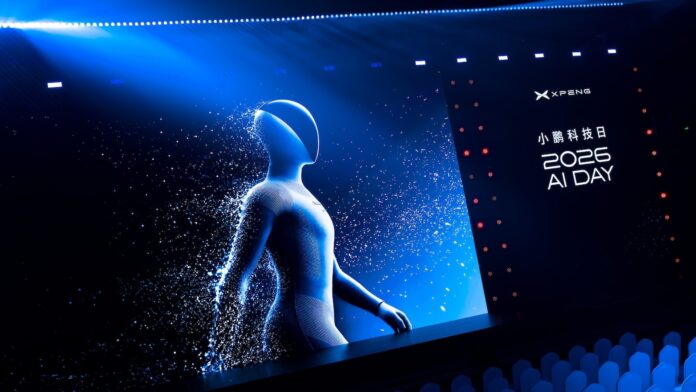

XPeng says its IRON humanoid robot enters hardware mass production in January 2027, and its robotaxis in Guangzhou have started carrying passengers with nobody in the driver’s seat. Both came out of the company’s AI Day, held under the title “Origin” at 2 PM Beijing time on Wednesday, Nov. 25 (1 AM ET / 10 PM PT Tuesday; 3 PM JST), on the campus of South China University of Technology in Guangzhou.
Then, at the press Q&A afterward, CEO He Xiaopeng was asked about Tesla’s new FSD v15 Reality View. His answer, as reported by Jiemian and D1EV: he hasn’t used it, he has only watched videos online, and the technology “isn’t that difficult.” The real question, he said, is whether it’s worth spending the car’s computing power on it.
IRON: production in January, a public launch later
He told the audience IRON moves into hardware mass production in January 2027, according to state-run Xinhua Finance. XPeng’s own Weibo account says the formal public launch is targeted for the second quarter. (Xinhua Finance’s write-up said February, so treat the exact launch month as soft.)
“Hardware mass production” is a specific phrase. It means the factory starts building the physical robot in volume. It doesn’t mean you can buy one, and XPeng says IRON will keep learning through software and hardware updates after delivery, with what it calls token subscriptions and scenario services. In plain English, the robot will come with an ongoing software plan, the way a phone comes with a data plan.
What XPeng says it can do, from its Weibo posts during the event:
- Work around the clock, switching on its own schedule between shop guide, greeter, staff trainer and security patrol, and plug itself in to recharge.
- Hands built 1:1 to human scale with 21 finger joints, which XPeng says cover 33 types of fine movements.
- A solid-state battery, which XPeng calls an industry first in mass production (we covered that battery’s small-batch production in October).
- A body surface kept between 25°C and 40°C with soft covering, so touching it feels less like grabbing a machine.
- Training data from a roughly 50,000-square-meter “robot data factory” where IRONs do real tasks in mock workplaces.
XPeng brought seven IRONs to the event, and one gave a speech on stage in Chinese and English. XPeng says it needed no remote control, a point the company clearly wanted to make after some viewers suspected a person inside the robot at last year’s debut.
He was blunt about the timeline, though. Sina quoted him telling reporters that building an advanced general-purpose robot is 20 times harder than building a car, and that he expects robots to enter homes, workplaces and factories at scale only in 2029 or later. That’s an unusually honest line from a CEO on launch day.
Robotaxi: the driver’s seat is empty
On the robotaxi side, He posted on Weibo on the morning of Nov. 25 that XPeng’s robotaxi had begun rides with no safety officer in the driver’s seat, eight months after it started testing with one, according to Sina. The Paper adds that XPeng got a Level 4 demonstration license 11 months after launching the business, and plans driverless demonstration operations in some areas by the end of 2026. These are invitation-style rides for now, not a public taxi service.
Post embedded from XPENG’s official X account (@XPENG_Global).XPENG Robotaxi now offers driverless rides! 🚗
— XPENG (@XPENG_Global) November 25, 2026
Devin Olsen, David Moss & Spencer, who tested intelligent driving across Canada, just tried it. Their take? "So reassuring. If I lived here, I'd buy one."
Incredibly smooth and excellent steering. Worth the world's wait!
$XPEV
XPeng also showed YOYO-01, its first robotaxi model built for commercial fleets, due in 2027, reported by IT Home, The Paper and CnEVPost. IT Home quotes He saying XPeng won’t run the fleet itself. It wants to be the technology supplier, selling partners a ready-to-deploy robotaxi package. That’s a different plan from Tesla’s, which runs its own Robotaxi network and its own app.
The fine print for XPeng car owners
Two changes matter to people who already drive XPengs. First, a distilled version of its second-generation VLA driving model goes to cars with dual Nvidia Orin-X chips in December, IT Home reported. (VLA means “vision-language-action”: one AI model that sees the road, reasons about it in something like language, and outputs driving actions.) Second, from the second quarter of 2027 XPeng’s Turing AI driver assistance becomes a subscription for new buyers worldwide, while anyone who orders before then keeps it for life, according to Xinhua Finance. Tesla owners will recognize that move.
XPeng also said a software update will lift its 5C fast-charging cars to 6C without new hardware. (“5C” means the battery can take a charge at five times its capacity per hour, so roughly 12 minutes from empty to full in theory. 6C is faster still.)
The EVX Take
He Xiaopeng is right that drawing a pretty 3D street isn’t the hard part, and Tokyo’s Turing proved it by mocking up Reality View in about seven hours. But Tesla’s point was never the graphics. As Musk described it, the picture comes from the same network that’s doing the driving, which is why it’s interesting at all. On humanoids, XPeng’s January hardware date puts real pressure on Optimus, which Tesla has said will get its next-generation AI5 chip. For Japan, the useful comparison is the job list. Shop guide, greeter and night security are exactly the roles Japanese retailers and building managers struggle to staff, and Japan has the industrial robot makers to build for them. Whoever puts a reliable, rentable humanoid into a Japanese store first, Chinese, American or Japanese, gets a very good customer.
Sources: Xinhua Finance, IT Home, The Paper, Jiemian, D1EV, Sina (He Xiaopeng on Weibo), Sina Finance, XPeng on Weibo, CnEVPost, XPENG on X.
Image: The main stage at XPeng AI Day 2026 in Guangzhou. Image: XPENG via its official X account (@XPENG_Global) (cropped).Follow @teslaloha on X for more

