
Japan Airlines says Starlink is now showing up in the numbers. In its first-half results on Nov. 2, JAL credited the completed rollout of Starlink across ZIPAIR’s whole fleet, together with flexible pricing, for a 12.3% jump in passenger revenue at its long-haul low-cost arm for April through September. ZIPAIR’s load factor climbed from 73.7% a year earlier to 87.8%.
It’s one line in a long earnings report, and it’s an unusually direct one. Airlines rarely name a Wi-Fi supplier as a reason revenue went up. “The enhancement of product value through the completed installation of ‘Starlink’, high-speed internet service across all aircraft, and flexible pricing strategies responding to the market, led to a 12.3% increase in passenger revenue year-on-year,” JAL wrote (the Japanese version says the same).
The numbers
JAL’s detailed segment figures, summarized by the Japanese aviation site sky-budget, fill in the rest. ZIPAIR’s passenger revenue for the half came to ¥42.9 billion (about $271 million USD). In the July–September quarter alone it rose 19.3% to ¥20.5 billion (about $129 million).
The interesting part is how it got there. ZIPAIR actually flew less capacity. Available seat-kilometers fell 9.7% to 5,095 million. Yet paying passengers rose 5.3% to about 710,000, and revenue passenger-kilometers rose 7.6%. Fewer seats, more people in them. The average fare went up too, from ¥56,753 to ¥60,491 (about $358 to $382), a 6.6% increase. Put together, revenue per available seat-kilometer rose 24.4% for the half and 33.4% in the second quarter.
In the July–September quarter on its own, the load factor was 87.1%, up 16.9 points. For a low-cost carrier flying 787s across the Pacific, that’s a very full airplane.
Free, on every seat
ZIPAIR, which JAL owns 100%, flies eight Boeing 787-8s from Narita to cities including Bangkok, Seoul, Honolulu, Singapore, Los Angeles, San Jose, San Francisco, Vancouver and Houston, and it added Kuala Lumpur in October. It started Starlink service on Feb. 26, 2026, after testing with SpaceX since 2023, and finished installing it on all eight jets on May 5 working with Boeing Global Services. ZIPAIR says it was the first airline in Asia with Starlink on its entire fleet, and Aviation Wire reported at the time that the Wi-Fi is free on every flight, for every seat class, on passengers’ own phones and tablets.
“We’re proud to be able to offer free high-speed internet as a new basic service of air travel,” ZIPAIR President Yasuhiro Fukada said in the May announcement. Free matters here. A low-cost carrier usually charges for everything except the seat, so giving away the one thing passengers on a 10-hour flight most want is a deliberate choice.
A fair caveat
JAL doesn’t separate how much of the gain came from Starlink and how much from pricing, and both moved at once. Cutting capacity by almost 10% also pushes load factors up on its own. Fuel costs, meanwhile, hit the whole LCC segment hard. JAL’s LCC business, which includes ZIPAIR and Spring Japan, grew revenue 11.4% to ¥65.8 billion (about $415 million), but its EBIT fell 73.0% to ¥1.8 billion (about $11 million). So Starlink didn’t make ZIPAIR rich. JAL simply thinks it helped sell the seats.
That lines up with what American carriers have been saying. United CEO Scott Kirby recently called Starlink the airline industry’s “biggest competitive advantage” (our story), and Air Tahiti Nui announced this week that it will offer free Starlink Wi-Fi across its fleet starting in 2027, TeslaNorth and Drive Tesla Canada reported. In Europe, easyJet picked Starlink for its whole fleet from 2027 (our story). ZIPAIR’s numbers are the first hard figures from Asia.
The EVX Take
For travelers in Japan this is the most concrete Starlink data point yet, and it comes from a Japanese company’s own filing rather than a SpaceX slide. ZIPAIR remains the only Japanese airline with Starlink across its fleet (Sankei called it the only one in the country when the rollout finished). ANA is rolling out Viasat systems on its international fleet, and JAL told Business Insider Japan in May that its current jets use geostationary satellites, with a new system that also uses low-Earth-orbit satellites coming on new 737-8s, A350-900s and 787-9s. It didn’t name the provider. If the parent company can see a revenue lift at its budget subsidiary, the obvious question in Tokyo is how long its full-service fleet waits. It’s also a quiet boost for Starlink’s broader standing in Japan, where KDDI already sells it and where satellite service on phones is the next fight (see our AT&T and AST SpaceMobile story for the Rakuten side of that contest). ZIPAIR gets two new 787s this fiscal year and plans to roughly double in size by the early 2030s, so the Starlink fleet in Japanese colors is about to get bigger.
Sources: JAL Group first-half results (English), JAL Group first-half results (Japanese, PDF), sky-budget (ZIPAIR segment figures), ZIPAIR press release, May 8, 2026, Aviation Wire, Sankei Shimbun, Business Insider Japan, TeslaNorth, Drive Tesla Canada. Currency conversions at about ¥158 per US dollar.
— The EVX News team
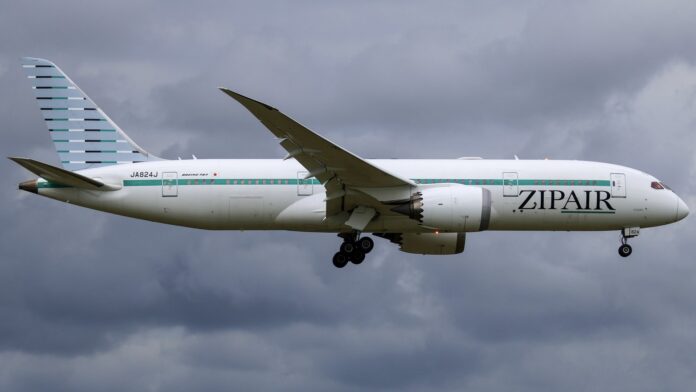
Featured image: ZIPAIR Boeing 787-8 JA824J arriving at Narita on flight ZG29 from San Jose (June 12, 2026). Photo: S5A-0043 / Wikimedia Commons (CC BY 4.0, resized).

