
Tesla’s driver-assistance software just lost its lead foot in Europe. The Dutch vehicle authority RDW said on Tuesday, Nov. 3 that it has assessed and approved a set of changes to FSD (Supervised), cutting the most the system can be set to exceed the speed limit from +50% to +10% and making the European name, Tesla Assisted Driving (TAD), official inside the car.
The changes cover Tesla models with the system and Hardware 4 or later, and they’ll arrive as an over-the-air update. According to the RDW’s Dutch-language release, the new rules are:
- The driver-set speed margin is capped at +10% (it was +50%).
- Every time the car starts, that margin goes back to 0%, and other speed-related functions start switched off.
- “Tesla Assisted Driving” replaces FSD (Supervised) on the screen, in the owner’s manual and in all other driver information.
Put in road terms, on a 50 km/h city street the old maximum setting let the car aim for 75 km/h. Now it tops out at 55. On a Dutch motorway with the daytime 100 km/h limit, the ceiling drops from 150 to 110.
Why the RDW’s sign-off matters
The RDW is the regulator that gave the system its first European approval in April, and every country that has said yes since has done it by recognizing that Dutch approval. So this isn’t a new approval. Tesla asked the RDW to review what the agency calls “minor changes,” and the RDW folded them into the existing one. It said it found no adverse or unintended effects on how the system works or how the car drives, so the type approval stays valid for the same use, with no amendment or extension needed.
The agency has notified the nine other countries that adopted its approval: Belgium, Denmark, Estonia, Croatia, Latvia, Lithuania, Slovenia, Slovakia and Czechia. It also repeated that the name change doesn’t change what the system is. It’s still driver assistance, and the driver is still responsible for the driving.
Owners have been here before. When Latvia made it 10 countries last week, its regulator listed a lower speed ceiling and an offset that resets after every trip among the changes it had weighed. Now the RDW has put the numbers in writing, and they come to the whole approval, not one country.
Germany’s checklist, ticked
The +10% figure isn’t random. In an Oct. 6 statement, Germany’s transport ministry said Minister Steffen Bilger and Tesla had agreed in September that the system may exceed the speed limit “by a maximum of ten percent,” and called the FSD name “somewhat misleading.” Tesla offered the Tesla Assisted Driving name, and Bilger said he would push for timely EU-wide approval on that basis.
Both of Germany’s asks are now in the Dutch paperwork. Not a Tesla App called them “the exact changes Germany (and others) asked for,” and Drive Tesla Canada, Teslarati and TeslaNorth reported the same details from the RDW release.
EU-wide approval still runs through the Technical Committee on Motor Vehicles (TCMV), which needs at least 15 of the 27 member states representing at least 65% of the EU’s population. The RDW said those talks are confidential and wouldn’t comment on them. A vote is expected in December. The 10 approving countries hold only about 14% of the EU’s people. Add Germany and the newly supportive Italy, which flipped to “yes” last week, and you’re near 46% by our earlier count. France and Spain are still the swing votes.
The EVX Take
Tesla gave up a setting most drivers in Europe would never legally use anyway, and in return it removed the biggest objection standing between it and a December vote. That’s a good trade. It also shows what regulators outside the US want before they say yes to supervised city driving: a hard speed cap, safe defaults at every start, and a name that doesn’t promise more than the system does. Japan should pay attention, because the timing lines up almost to the hour. Japan’s transport ministry (MLIT) holds a vehicle safety study group meeting today, Wednesday, Nov. 4, from 2:00 to 4:30 PM JST (midnight to 2:30 AM ET Wednesday / 9:00 to 11:30 PM PT Tuesday), and the agenda includes setting up a working group on an “L2++” certification, the category FSD (Supervised) falls into, as we reported Monday. If Japan ever approves Tesla’s system, expect Europe’s conditions to be the starting template, with the 10% cap meaning about 110 km/h on a 100 km/h expressway. Japanese owners who’ve already paid for FSD would happily take that deal.
The RDW didn’t give a date for the update. Owners in the 10 approving countries should see the new name and the tighter speed menu in an upcoming software release, and MLIT says it will post today’s meeting materials once the meeting is over.
Sources: RDW (English and Dutch releases), German Federal Ministry of Transport, Not a Tesla App, Drive Tesla Canada, Teslarati, TeslaNorth, MLIT.
— The EVX News team
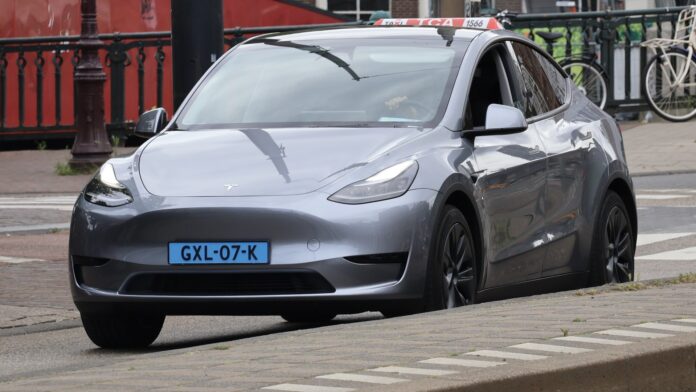
Featured image: A Tesla Model Y taxi in Amsterdam, the Netherlands, June 2025. Photo: S5A-0043 via Wikimedia Commons, CC BY 4.0 (cropped).


