
Japan’s transport ministry is preparing to certify driverless cars that have no steering wheel or brake pedal under one standard set of rules, instead of approving each vehicle one at a time, the Nikkei reported on Monday. The revised safety standards would cover Level 4 and Level 5 vehicles and apply from December, a change aimed squarely at making robotaxis cheaper to build in volume.
According to the Nikkei report, published at 5:00 PM JST on Nov. 2 (3:00 AM ET / 12:00 AM PT Monday), the Ministry of Land, Infrastructure, Transport and Tourism (MLIT) is considering “uniformly” certifying vehicles without steering wheels or brake pedals as long as they meet the revised standard. Until now, it has assessed the safety of these vehicles case by case. The plan is due to come up at a ministry vehicle safety meeting on Wednesday.
What would change
Japan’s current vehicle safety standards assume someone is sitting in a driver’s seat. MLIT’s own expert panel spelled out the problem in a March 2025 report on automated-vehicle safety. Vehicles without a driver’s seat or conventional controls, it said, can only be put into service by getting an individual exemption under Article 55 of the safety standards. With more of them expected, the panel recommended rewriting the standards themselves to cover driverless vehicles rather than handling each one through exemptions.
That’s the change the Nikkei now says is coming. Based on its reporting, as summarized by EVwire, vehicles certified under the new rules would not need a steering wheel, pedals, rearview mirrors or a driver monitoring system. That cuts parts cost and frees up the cabin for different seat layouts. Crash tests with dummies would still be required for vehicles that carry passengers, such as taxis and buses. Unmanned cargo vehicles would be exempt from those tests. Both types would still need measures that can avoid an accident if a system fails.
An MLIT official told the paper the goal is to “facilitate mass production” and help Japan hit its adoption target, which the Nikkei put at about 10,000 Level 4-capable buses, taxis and other vehicles by fiscal 2030. MLIT hasn’t announced the revision itself, so the December timing and the details come from the Nikkei for now.
Wednesday’s meeting, and an “L2++” surprise
The meeting is real and on the calendar. MLIT’s press release sets its second vehicle safety study group meeting of the fiscal year for Wednesday, Nov. 4, from 2:00 to 4:30 PM JST (12:00 to 2:30 AM ET Wednesday / 9:00 to 11:30 PM PT Tuesday, Nov. 3). One agenda item is “the direction of measures for spreading safe automated vehicles,” which is where the steering-wheel rule is expected to land.
Another item got less attention. The ministry plans to set up a working group on an “L2++ excellence certification system.” As SDV Sector noted, the notice doesn’t define L2++. In industry use, L2+ and L2++ usually describe advanced driver assistance that can handle much of a trip, city streets included, while a human supervises. That’s the category FSD (Supervised) falls into. A certification that grades systems above the legal minimum would be a new tool for Japan. The meeting is closed to the public, and MLIT says it will post the materials afterward.
Why December
The timing tracks the global rulebook. On June 24, 2026, UNECE’s World Forum for Harmonization of Vehicle Regulations (WP.29) adopted what it called the first global rules allowing fully autonomous vehicles, a UN regulation on automated driving systems (UN News). Japan is one of the main members of the WP.29 agreements and usually brings its domestic rules in line with them. The US is not part of that mutual-recognition system and has been writing its own rules. NHTSA recently proposed new lamp rules for driverless vehicles with no steering wheel (our story).
The obvious beneficiaries are the companies already building vehicles with no wheel at all. Tesla’s Cybercab has no steering wheel or pedals and has been carrying riders in Tesla’s Texas Robotaxi service. Tesla brought one to Japan for a Cybercab Japan Tour in Tokyo, Osaka and Nagoya in September, though Reuters reported at the time that plans for service in Japan were undecided. Waymo, for its part, plans to start testing a Level 4 fleet based on the Toyota bZ4X in Japan in 2027 (our story), and that car keeps its steering wheel.
The EVX Take
This is the most useful thing Japan could do for robotaxis right now, and it’s mostly paperwork. A one-off exemption works for a pilot shuttle in one town. It doesn’t work for a carmaker that wants to build thousands of identical vehicles and sell them to taxi operators in Tokyo and Osaka. Japanese suppliers win too. Companies like Tier IV and the big parts makers get a clear target instead of a negotiation. For Tesla, the steering-wheel rule matters for Cybercab, but the L2++ working group may matter more to Tesla owners in Japan who already have FSD-capable hardware and are still waiting. If that group ends up writing a grading system that FSD (Supervised) can pass, it could become the route to approval here. We’ll read Wednesday’s materials as soon as MLIT posts them.
Sources: Nikkei, EVwire, MLIT press release (Oct. 30), MLIT automated-vehicle safety study group report (March 2025, PDF), SDV Sector, UNECE, UN News, Tesla Japan (PR Times), Reuters Japan.
— The EVX News team
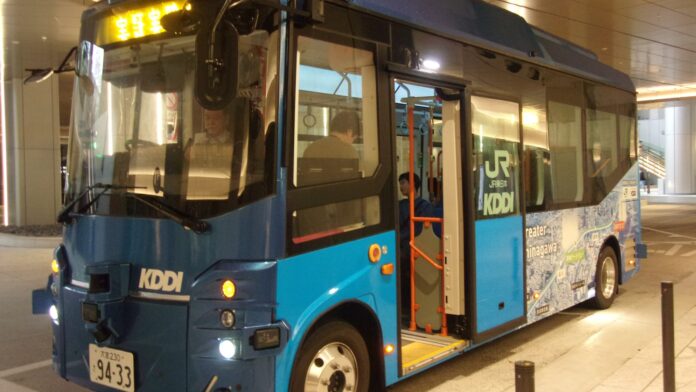
Featured image: An autonomous bus with JR and KDDI branding at Takanawa Gateway City, Tokyo (April 2026). This bus has a driver’s seat with an operator on board. Photo: 番記者 / Wikimedia Commons (CC0, cropped).

