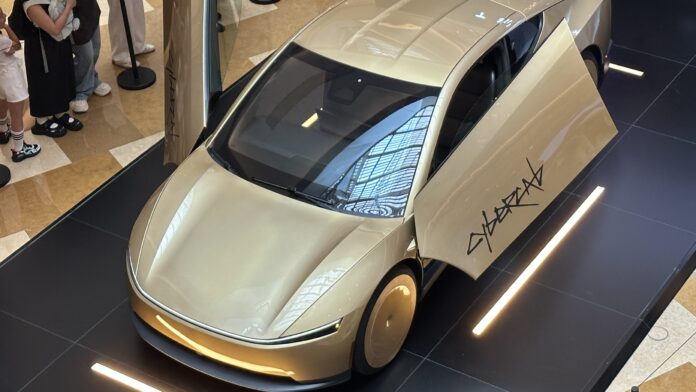

Tesla’s Cybercabs went to the Formula 1 race. More than 50 of the gold two-seaters were spotted dropping off passengers at Circuit of the Americas in Austin on Sunday, race day for the United States Grand Prix, the biggest crowd test Tesla’s driverless service has faced so far.
Sawyer Merritt posted the count at 1:45 PM ET / 10:45 AM PT (2:45 AM JST Monday), with video of the cars arriving at the track, noting that race day alone was expected to draw more than 120,000 people. Tesla’s own Robotaxi account followed a couple of hours later with a one-word caption:
Lights out was 3 PM local time, which is 4 PM ET / 1 PM PT (5 AM JST Monday), so those drop-offs were the easy half. The harder job comes afterward, when a six-figure crowd tries to leave a racetrack at once and a driverless car has to sit in the same traffic as everyone else.
43 more Cybercabs in a day
Tesla stocked up for the weekend. The Texas Department of Motor Vehicles’ automated-vehicle roster now lists 970 Tesla Robotaxi vehicles, 463 Cybercabs and 507 Model Ys, according to the Texas AV Tracker and FSD Database, which both mirror the state data. All 43 additions on Saturday were Cybercabs, arriving in a batch of 11 in the afternoon and 32 more just before midnight Central time. When we wrote about the roster at 927 on Friday, the Cybercab count was 420. The car with no steering wheel is now about 48% of Tesla’s registered Texas fleet, and the Model Y line hasn’t moved in days.
A registration is not a ride, to be clear. Community site Robotaxi Tracker says riders have logged trips in 208 different Cybercabs so far, about 44% of the registered ones. Its traffic-camera count did jump on Saturday, qualifying day: 1,588 Cybercab sightings, the most in its 30-day log, with 1,066 of them showing nobody in the driver’s seat.
Built for this weekend
The race-day run was set up on Friday, when Tesla stretched the Austin geofence southeast to take in the track and pushed last call to 1 AM, as Drive Tesla Canada and TeslaNorth reported. Robotaxi Tracker put the addition at about 8 square miles, taking Austin to 272. Early app searches for COTA venues came back “Service blocked,” TeslaNorth noted, so it wasn’t obvious the cars would get close to the gates. Sunday’s video says they did.
Tesla had company. Merritt also posted a Zoox, a Waymo and a Cybercab side by side on an Austin street, about as close to a robotaxi starting grid as the city gets.
The next stops are already on the calendar. Tesla said on its Q3 call that Cybercab rides start in Dallas in November, and Tesla AI vice president Ashok Elluswamy said 2 AM service is coming “pretty soon,” with 24/7 operation targeted before year-end. Washington is getting ready too: NHTSA’s proposal for cyan robotaxi lamps, which Not a Tesla App also covered, would give cars like the Cybercab a light that tells a parking-lot attendant nobody is going to wave back. Riders who caught one this weekend can now also see what’s behind them on the way home.
For readers in Japan, Suzuka’s race crowd still goes home by train and car. Tesla’s driverless service is U.S.-only, and FSD (Supervised) isn’t approved here yet.
Sources: Sawyer Merritt on X (2), Tesla Robotaxi on X, Texas AV Tracker (TxDMV data), FSD Database, Robotaxi Tracker, Drive Tesla Canada, TeslaNorth, Tesla Oracle, Not a Tesla App.
— The EVX News team
Featured image: A gold Tesla Cybercab on display with its doors open, September 2026. Photo: JustAnotherCarDesigner, via Wikimedia Commons, CC0 (cropped).

