
Tesla has started rolling out software update 2026.44.3.1, and the headline feature is one owners have asked for over several winters: a button that warms the battery for fast charging whenever you want, without first telling the navigation you’re headed to a Supercharger. You can press it in the car or start it from the Tesla app.
The release notes, archived by Not a Tesla App and Tessie, call it Manual Battery Preconditioning and mark it “Available Worldwide.” Tesla suggests starting about an hour before you plan to plug in. Once the pack reaches its target temperature, the car holds it there for 30 minutes. In the app, the path is Charging, then Precondition for Fast Charging, and it needs app version 4.63.0.
What preconditioning actually does
What it means, in plain English. Lithium-ion cells take a charge fastest when they’re warm. A cold battery has to protect itself, so the car limits how much power it will accept, and a Supercharger that could deliver 250 kW might crawl along at a fraction of that for the first part of the session. “Preconditioning” is the car using its heating system to bring the pack up to temperature before you arrive.
Until now, Tesla did this automatically when you navigated to a Supercharger or a fast charger the car recognized. That works on a road trip. It works less well when you’re driving 10 minutes to the charger near your office, because the car doesn’t have time to get warm, or when you’d rather not punch a destination into the map you already know. Drive Tesla Canada points to exactly that short-trip case as the one where the manual control helps most. It also notes a side benefit: warming the pack while plugged in at home before a winter drive can mean better regenerative braking from the start, though heating all the way to fast-charge temperature uses more energy than everyday driving needs.
TeslaNorth reported the same release-note text. The app half of the feature isn’t a surprise: the wording first appeared in code for app version 4.63.0 on Nov. 18, according to NotATeslaKiller, and now the car side has caught up.What else is in 2026.44.3.1
The rest of the notes are mostly carried over from earlier 2026.44 builds:
- Charger Network View: charger pins on the map now cluster as you zoom out, so you see network coverage instead of a wall of icons.
- Automatic Collision Evasion (HW4): FSD (Supervised) can step in if you’re driving manually and the car detects you’re not paying attention, or if FSD may have been switched off by accident.
- FSD (Supervised) v14.3 Lite for HW3 cars: Tesla says it “distilled” lessons from HW4’s v14 into the older computer, adding parking, unparking and reversing, plus Arrival Options and Speed Profiles.
- FSD (Supervised) v14.3.13 for HW4 cars, plus minor fixes.
FSD isn’t available in Japan, so for Japanese owners the practical changes are the preconditioning button and the cleaner charger map. (The last update that made a splash in Japan was a fun one: Halloween Mode with skeleton pedestrians.) Readers on HW4 in the U.S. are mostly waiting on FSD v15 and its Reality View anyway.
Who gets it, and when
Very few cars so far. TeslaFi’s sample showed just two vehicles on 2026.44.3.1 as of Friday, with a handful of installs pending, and the first recorded install was a Model Y Performance in Austria. The notes confirm the feature for Model 3 and Model Y, while trackers still show question marks next to Model S, Model X and Cybertruck. Tesla ships updates in waves, so the usual advice applies: leave the car on Wi-Fi and check Controls, then Software. Tesla’s separate holiday update is still expected in December.
Why Japan should care
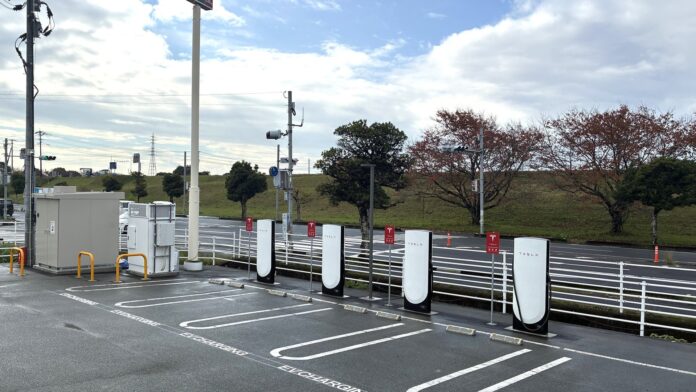
Tesla Japan’s own count, published Oct. 23, was 156 Supercharger sites and 768 stalls nationwide, and the network keeps filling in. Just this morning Tesla Charging posted a new four-stall site in Yamato-cho, Saga, in northern Kyushu, on the same day Tesla Japan opened the two new stores in Kitakyushu and Date, Fukushima it announced earlier this month.
Post embedded from Tesla Charging’s official X account (@TeslaCharging).New Tesla Supercharger: Saga, Japan – Oaza Niiji, Yamatocho (4 stalls) https://t.co/S6fDYzj2cz pic.twitter.com/4mQoOuJZFx
— Tesla Charging (@TeslaCharging) November 27, 2026
Many of the newer Japanese sites look like that one: four stalls in a shop parking lot rather than a big highway hub. Seven-Eleven Japan said in July that it opened its first in-store Supercharger in Kawasaki, a 250 kW, four-stall site billed at ¥37 to ¥200 a minute (about $0.23 to $1.26), and planned about 10 stores in fiscal 2026. Those are stops you make on the way to somewhere else, usually close to home. That is the short-hop charging the old navigation trigger handled worst.
There’s also CHAdeMO. Since Oct. 23, Tesla Japan has sold a new CHAdeMO adapter so its cars can charge faster at roughly 14,000 public fast chargers at convenience stores, roadside michi-no-eki rest stops and highway service areas, according to the same release. A manual button lets the owner warm the pack regardless of which fast charger is at the end of the drive.
The EVX Take
This is a small feature that tells you Tesla is listening to cold-climate owners. In Hokkaido, Tohoku or the Nagano mountains, a cold pack can stretch a quick top-up into a long wait, and most Japanese owners don’t live next to a 250 kW highway hub. They top up at a four-stall site behind a convenience store or a mall. The fix costs Tesla nothing in hardware and works on cars already on the road, which is still one of the company’s most underrated advantages over legacy rivals. The one thing to watch is how fast 2026.44.3.1 moves beyond its first handful of cars. A winter feature is most useful before the first snow.
Image: Tesla, via Tesla Charging’s official X post announcing the Saga Supercharger (cropped).Follow @teslaloha on X for more

