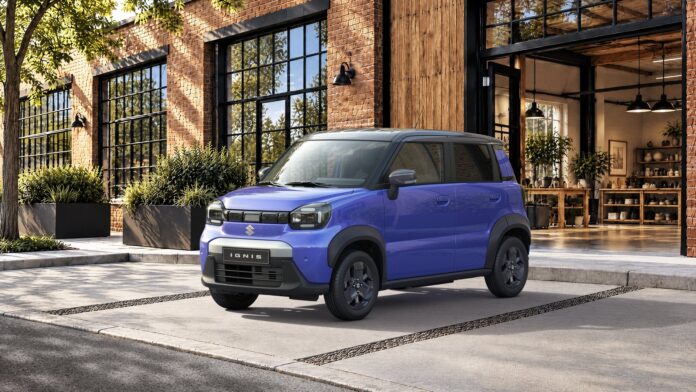

Suzuki has unveiled the all-new Ignis, its first compact EV built for the global market, and it’s essentially Japan’s new e SKY kei car bulked up for European roads. The four-seater has a 26 kWh LFP battery and a 67 kW motor, and goes on sale in Europe and other markets from around summer 2027, Suzuki said after an online world premiere on Wednesday, Nov. 25.
No price yet, and no official range. But the recipe is clear, and for a Japanese brand trying to hold its ground in Europe, it’s an interesting one.
A kei car, stretched
The Ignis is based on the body and powertrain of the e SKY, the kei EV Suzuki put on sale in Japan on Nov. 16 (we covered its launch in our Japan & China EV Week roundup). Kei cars are Japan’s tiny-car class, with strict limits on size and engine output in exchange for tax and parking breaks. Freed from those rules, the European car grows. According to the pre-homologation specs Suzuki UK published, it measures 3,570 mm long, 1,565 mm wide and 1,635 mm tall on a 2,460 mm wheelbase. Autonext works out that’s 175 mm longer and 90 mm wider than the e SKY, with the same wheelbase, so all the extra length sits in the bumpers.
Power grows too. The motor makes 67 kW (about 91 hp) and 133 Nm. Japan’s kei class has a voluntary output ceiling of 64 PS (47 kW), so the Ignis is noticeably stronger than its home-market sibling. Autonext puts the curb weight at 1,080 kg, which is very light for an EV, and a 4.5 m minimum turning radius means it will U-turn in places where most crossovers need three tries.
Under the skin, Suzuki uses a new eAxle that combines the motor, inverter and reduction gears in one unit, an LFP battery chosen for safety and long life, and its dedicated EV platform, HEARTECT-e, with the battery laid flat under the floor. European outlets including Electrifying.com report DC fast charging at up to 50 kW, with a charge to 80% in under 30 minutes.
What it means, in plain English. LFP (lithium iron phosphate) batteries hold a bit less energy for their weight than the nickel-based kind in many bigger EVs, but they’re cheaper, tolerate frequent full charges better and last a long time. For a small city car that mostly does short trips, that trade is usually a good one. An eAxle just means the motor and its electronics come as one compact box, which saves space and weight.
The range question
Suzuki hasn’t given a WLTP figure for Europe. The Japanese e SKY is rated at 310 km on Japan’s WLTC test, but WLTC is gentler than Europe’s WLTP, and the Ignis is bigger and heavier, so expect the European number to come in lower. Suzuki says prices and full specs will come closer to launch.
The target is obvious. Automotive News Europe frames it as a rival to the new Renault Twingo, and Autonext lines it up against the Dacia Spring. The Ignis name still carries weight there. In Germany, the old gasoline Ignis made up more than a quarter of Suzuki’s sales before it was dropped, per Autonext.
In the Japanese press release, Suzuki President Toshihiro Suzuki calls it the company’s first compact EV for the world market, built with packaging skills polished in Japan’s kei car business (our translation) and the company’s “Sho-Sho-Kei-Tan-Bi” motto: smaller, fewer, lighter, shorter, neater. Suzuki also says the car was road-tested in Europe and other regions, with power delivery and suspension tuned for each market.
The EVX Take
This is the most Japanese answer possible to the Chinese EV wave in Europe. Chinese brands have overtaken Japanese carmakers in 39 countries this year, Germany among them, largely by selling well-equipped EVs at sharp prices. Suzuki isn’t trying to out-spec them. It’s betting that what Japan already does better than anyone, building very small, very light cars cheaply, carries over to electric. The e SKY starts at ¥2,120,000 (about $13,300) in Japan, so the bones are cheap. The open question is whether Suzuki can keep the price low after shipping and European homologation, because a city EV at Dacia money with a Japanese badge would be a real problem for the competition. For buyers in Japan there’s a side benefit, too. Every Ignis sold in Europe spreads the cost of the platform it shares with the e SKY, and more volume is how kei EVs get cheaper here.
Image: Suzuki Motor Corporation, official press image of the all-new Ignis (cropped).Follow @teslaloha on X for more

