
Tesla has set up a new German company whose registered business address is the headquarters of EMAG, a struggling machine-tool maker in Salach, near Stuttgart, that builds production lines for the tiny precision gears inside humanoid robot joints. Neither company has confirmed a deal. But the paperwork, plus local reporting that about 220 EMAG employees will move to Tesla, points in one direction: Optimus.
The new entity is called Tesla Machining Technologies Management SE. It started life on Aug. 26 as a ready-made shell company named “Blitz 26-299 SE,” was renamed earlier this month, and is listed at the Munich district court under HRB 315756 with €120,000 (about $131,500) in share capital, Chip Dispatch reported from the register. Its address is Austraße 24 in Salach, which is EMAG’s home base. (Anyone can look the entry up in Germany’s official Handelsregister.)
Business Insider Germany, working from a notice in the federal gazette, says three people run it: Maximilian Stromberger, the 33-year-old head of sales at Tesla Germany; an American robotics engineer; and the head of HR at Tesla’s Grünheide car plant outside Berlin. That last name is the telling one. You don’t need an HR chief to hold a passive stake in a supplier. You do need one if people are about to change employers.What the local paper says
The Südwest Presse, the regional daily that has been on this story for over a week, reported on Wednesday that around 220 EMAG employees are expected to work for Tesla in the future, that the two companies have apparently been working together for some time, and that the cooperation is about humanoid robots. According to Business Insider, EMAG told its workforce about the Tesla plans at a staff meeting on Nov. 16. Neither Tesla nor EMAG answered repeated requests for comment, so treat the 220 figure and the robot link as reported, not confirmed. Drive Tesla Canada picked up the same details and notes that the Tesla company was registered at EMAG’s headquarters with Stromberger as managing director.
EMAG needs a partner. The group, whose roots go back to 1867, made €496 million (about $544 million) in revenue in 2024 and lost €42 million (about $46 million), per Business Insider. In November 2025 it announced 455 job cuts in Germany, roughly a third of its domestic staff, about 300 of them in Salach, and it has been looking for investors ever since.
The part that matters: robot gears
EMAG’s traditional business is turning, grinding and gear-cutting machines for car parts such as transmissions and drivetrains, which is exactly the business that has shrunk. Its newer pitch is in robotics. On its robotics page, EMAG says it offers manufacturing systems for “the three key gear components in robotic actuators”: flexsplines, wave generators and planetary gears, “with reproducible precision for high-volume production.”
What it means, in plain English. An actuator is a robot’s muscle: a motor plus a gearbox that turns fast, weak spinning into slow, strong movement at a joint. The most compact gearbox for that job is the strain wave gear. A wave generator (an oval cam inside a thin bearing) flexes a thin steel cup with teeth, the flexspline, so its teeth walk around a rigid outer ring. One stage can cut speed by 100 times or more, which is why it’s popular in robot arms and elbows. Planetary gears are the sturdier option for the big load-bearing joints like hips and knees.
The tolerances are brutal. EMAG says flexspline walls are under a millimeter thick, carry 100 to 400 teeth, and must run true to within 5 micrometers, about a twentieth of a human hair. It also says modern humanoids need at least 14 rotary actuators each. Making a few of those is easy. Making millions that all behave the same is the hard part, and that’s the problem Tesla has set itself.
Why Tesla would want this in-house
In its Q3 2026 update, Tesla said early Optimus production has begun on a high-volume line in Fremont. On the earnings call, Elon Musk said it would take “probably at least a year, maybe a little longer” to reach the line’s target of 20,000 robots a week, as Drive Tesla Canada reported. At that rate, even the low-end figure of 14 actuators per robot means hundreds of thousands of precision gearsets every week. Buying that many from outside suppliers is a supply risk. Owning the machines that make them is the Tesla way.
There’s a pattern here, too. Tesla bought German automation specialist Grohmann Engineering about a decade ago, wireless-charging firm Wiferion in 2023, and took over the Manz site in Reutlingen with more than 300 staff in early 2025. Business Insider counts EMAG as the next step in that vertical-integration habit. Tesla is also giving Optimus its newest AI5 computer before the cars get it, so the robot is clearly at the front of the queue for resources.
Competition is heating up as well. In China, XPeng says its IRON humanoid enters production in January, and every one of those robots needs the same kind of joints.
The EVX Take
If this goes through, the people who should pay closest attention are in Japan. The strain wave gear is so closely tied to Japan’s Harmonic Drive Systems that the Tokyo-listed company’s trade name became shorthand for the part, and Japanese suppliers such as Harmonic Drive Systems and Nabtesco are among the best-known names in precision robot reducers. Investors already treat humanoid robots as a story for these firms; Harmonic Drive led our Tokyo list with a 13.27% jump on Nov. 24. A Tesla that machines its own flexsplines in Germany is a customer that may never place the big order. Our read is that Tesla isn’t trying to beat Japan’s gear makers at their own game so much as making sure Optimus can’t be held hostage by a single supplier, the same logic that pushed it into building its own batteries and chips. For Japanese suppliers, the takeaway is that the volume Musk is talking about is real enough for Tesla to go and buy a factory for it.
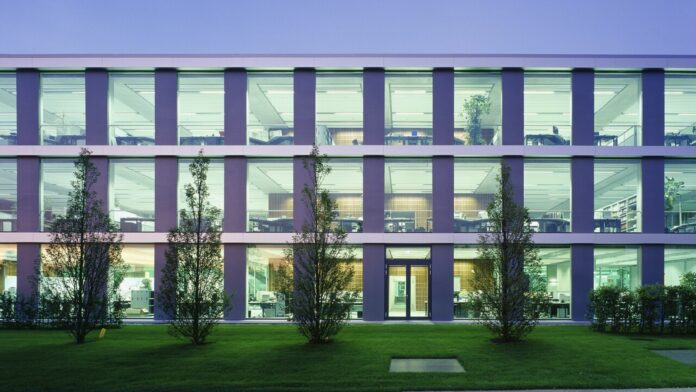
Photo: EMAG’s technical center in Salach, Germany. Photo by Zooey Braun, CC BY-SA 3.0, via Wikimedia Commons (cropped).Follow @teslaloha on X for more

