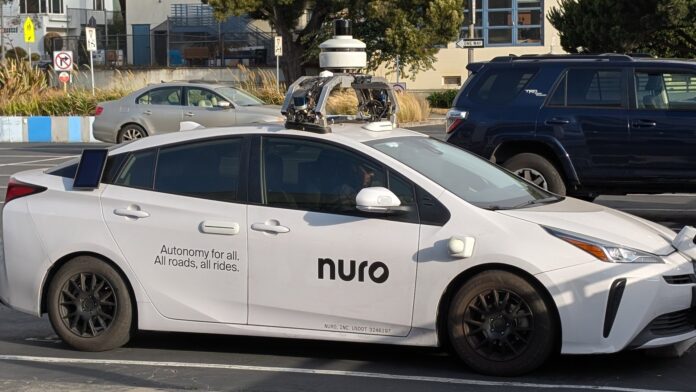

Nobody is sitting behind the wheel anymore. Nuro, Lucid and Uber said on Tuesday, Nov. 24, that their Lucid Gravity robotaxis are now driving on public roads in the San Francisco Bay Area with no safety driver on board. Employee rides come next, and a public launch on the Uber app is planned for the first quarter of 2027, according to the companies’ joint announcement.
Post embedded from Lucid Motors’ official X account (@LucidMotors).The driver is officially out.
— Lucid Motors (@LucidMotors) November 24, 2026
Our Lucid Gravity robotaxis driven by @Nuro are now testing fully driverless on public roads in the San Francisco Bay Area. Employee rides are next.
The future of mobility is getting closer—coming to @Uber in early 2027.
Lucid posted the news at 8:10 AM ET / 5:10 AM PT on Tuesday (10:10 PM JST, Nov. 24). The driverless testing covers four South Bay cities, Palo Alto, Mountain View, Los Altos and Sunnyvale, and will spread to more Bay Area cities next year. Lucid has delivered a fleet of more than 100 updated Gravity SUVs for this phase, the release on Business Wire says.
What “driverless testing” actually means
Until now, every one of these cars had a trained employee in the driver’s seat, ready to grab the wheel. That person is the safety driver. Taking them out is the step that separates a test program from a real robotaxi, because the software alone now has to handle everything, including the weird stuff.
It isn’t a public service yet. Only Nuro staff will ride first. Regular riders get access when the service opens in the Uber app, which the companies now target for early 2027. That’s a small slip from the late-2026 goal they had earlier, which Nuro COO Andrew Chapin called “a little bit of a push to the right” in an interview with Axios. Houston, where testing still has safety drivers, follows later in 2027.
The software is the Nuro Driver, a Level 4 system. Level 4 means the car drives itself with no human backup, but only inside a set area and set conditions. The California DMV’s permit list spells those out for Nuro’s driverless test permit: Santa Clara and San Mateo counties, day or night, light rain and fog allowed, speeds up to 45 mph. Nuro got that permit in May 2026, according to TechCrunch, and says it’s one of only six companies cleared to test with nobody behind the wheel in California.
The hardware is a sensor-heavy setup. Each Gravity carries cameras, lidar (a laser scanner that measures distance by bouncing light off objects) and radar, plus a roof “halo” that shows riders their initials. Before pulling the driver, Nuro ran the car through staged emergencies on a closed track in Las Vegas, including pedestrians stepping out and drivers running right-of-way.
The money behind it
This is Uber’s big bet on not building its own self-driving car. When the deal was announced in July 2025, Uber agreed to buy at least 20,000 Lucid vehicles. That commitment rose to at least 35,000 in April 2026, Drive Tesla Canada reports. TechCrunch says Uber’s investment in Lucid has grown from $300 million to $500 million, and that Uber also agreed to put nearly $500 million into Nuro. Uber and its fleet partners will own and run the cars, and rides will be sold only through Uber.
Where Tesla stands
Tesla took a very different road. Its Robotaxi service already runs with no one in the driver’s seat in Texas, and its Cybercab, which has no steering wheel at all, opened to public riders in Dallas last week (our Dallas story). Tesla also has more robotaxis on the Texas books than Waymo, with 1,507 registered as of Nov. 17. It does it with cameras only, no lidar.
California is another story. Tesla isn’t on the DMV’s list of driverless-testing permit holders, and Drive Tesla Canada notes it still holds only a permit to test with a safety driver there. Its Bay Area ride-hailing service still has a human at the wheel. So in Nuro’s home market, the Lucid cars are now a step ahead of Tesla on paper, even if Tesla is far ahead on cars on the road.
The EVX Take
The Bay Area milestone matters more to Japan than it first looks. Nuro has had a Tokyo office since August 2025, and its software has been driving Toyota Priuses on Tokyo streets with safety drivers since February, according to TechCrunch. Its Japan page says it works with the transport ministry (MLIT) and the National Police Agency. The California playbook (supervised miles, closed-course tests, then pull the driver) is the same one Tokyo would eventually see, and Nuro’s COO has openly called Japanese automakers “very interesting potential customers” (Japan Times/Bloomberg). With Waymo planning Toyota-built bZ4X robotaxis for Japan from 2027 (Toyota) and Zoox eyeing Japan too, Tokyo is turning into the place where lidar-heavy robotaxis and Tesla’s camera-only approach will finally be compared on the same narrow streets. The catch is regulation. Japan approves driverless service area by area, and for now Japanese Tesla owners can’t even use city-street FSD, so the first empty driver’s seat in Tokyo is more likely to belong to a fleet car than to anyone’s own Model Y.
Sources: Nuro and joint release (Business Wire), Lucid Motors on X, California DMV, TechCrunch, Axios, Drive Tesla Canada, Investing.com Japan, Nuro Japan, Toyota.
Photo: A Nuro test car (a Toyota Prius fitted with sensors) in San Francisco, July 2025. Photo by HaeB, CC BY-SA 4.0, via Wikimedia Commons (cropped).Follow @teslaloha on X for more

