
Tesla’s next self-driving chip, AI5, is going into the Optimus humanoid robot, and Tesla’s cars will stay on the current AI4 computer. Elon Musk said so on X on Sunday, Nov 22 at 7:09 AM ET / 4:09 AM PT (9:09 PM JST), answering an owner who asked whether he should hold off on replacing his older Tesla until AI5 cars arrive. Three minutes earlier, in another thread, Musk dropped a new detail on cost: AI4 “costs twice as much now due to memory and storage price hikes.”
It’s going to Optimus. Cars will remain at AI4. That’s enough to solve superhuman driving.
— Elon Musk (@elonmusk) November 22, 2026
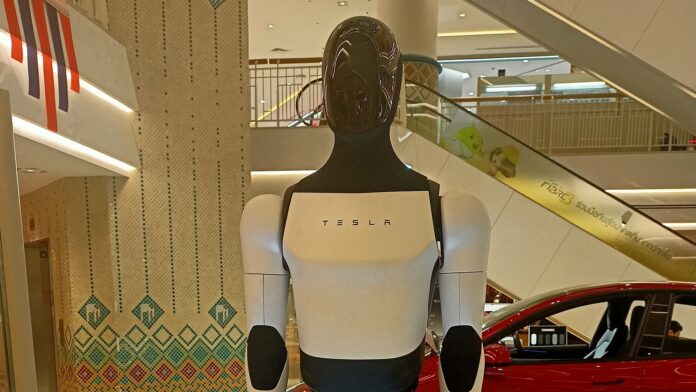
Lead image: a Tesla Optimus robot on display at the Central Chiangmai Airport mall in Chiang Mai, Thailand (April 2026). Photo by MikSed via Wikimedia Commons, CC BY-SA 4.0 (cropped).
The question came from an owner with an AI3 car (Tesla’s older Hardware 3 computer): “When will AI5 be in new cars? I feel like I should wait to upgrade from my AI3.” Musk’s reply was short. Reserve the new chip for the robot, keep the cars where they are. Drive Tesla Canada, TeslaNorth and EV (eletric-vehicles.com) all reported the exchange.
It isn’t a complete U-turn. When AI5 taped out in April (the point where a chip design is finished and sent to the factory), Musk was asked whether it would go into cars or robots and answered “Optimus and our supercomputer clusters,” adding that AI4 is enough for much better than human safety, according to EV’s timeline of his posts. On the Oct. 21 earnings call he said AI5 should be inside Optimus around April 2027. What’s new on Sunday is the flat “Cars will remain at AI4,” with no “for now” attached, plus the price tag.
The memory bill doubled
The cost remark came in a thread about how much computing power FSD v15’s new Reality View screen uses. “AI4 costs twice as much now due to memory and storage price hikes,” Musk wrote. He gave no dollar figure, and as TeslaNorth points out, he was talking about what the computer costs Tesla to build, not about car prices, FSD subscriptions or retrofits.
The timing fits what the chip market has been doing all year. Nikkei Asia reported on Nov. 3 that DRAM prices have roughly doubled since the end of 2025, because memory makers are sending supply to data centers first. Tokyo-based Kioxia said the average price of its NAND flash (the memory inside SSDs and car storage) jumped about 70% in the April–June quarter and another mid-20% in July–September, The Japan Times reported.
Later on Sunday, at 2:26 PM ET / 11:26 AM PT (Monday, Nov 23 at 4:26 AM JST), Musk answered Sawyer Merritt about the in-between chip owners have been calling “AI4.5.” It is “a relatively small performance improvement that is mostly due to needing to upgrade RAM to LPDDR5X,” he wrote. On the April earnings call, per EV, he described the same upgrade as going from 16 GB to about 32 GB of memory per chip, with roughly 10% more compute, and said the timing depended on Samsung. Musk didn’t say when it ships, or whether the Cybercab uses it.
What it means, in plain English
- AI3, AI4, AI5: the computers that run Autopilot and FSD. AI3 (also called HW3) is in many cars built before 2023. AI4 (HW4) is in today’s new Teslas. AI5 is the next design, which Musk says has roughly 12 times the compute of AI4.
- Compute: how much math the chip can do per second. Self-driving software is a big neural network (a program that learns from examples), and running it takes a lot of math, fast.
- Memory (DRAM, RAM, LPDDR5X): the chip’s short-term workspace, where it keeps the network and what the cameras just saw. LPDDR5X is a newer, faster, low-power type that phones use. Musk says the AI4.5 change is mostly about switching to it.
- Storage (NAND flash): the long-term memory that holds the software and maps, like the SSD in a laptop.
- Why Optimus gets AI5: a humanoid robot has to understand hands, objects and people, not just roads. Musk thinks driving can be solved on AI4, so the bigger chip goes where he thinks it’s needed more.
For owners, the short version is this. If you’re shopping for a new Tesla, there’s no AI5 car to wait for. If you own an AI3 car, nothing changed on Sunday. Tesla said on its first-quarter call that Hardware 3 “simply does not have the capability to achieve unsupervised FSD,” Drive Tesla Canada noted, and there’s still no date for the upgrades or discounted trade-ins Musk has talked about.
The EVX Take
Keeping cars on one computer is mostly good news for people buying now, because the car you buy today is the car Tesla is building its driving software for. That matters in Japan, where FSD (Supervised) still isn’t approved and the current Model 3 and Model Y are already AI4 cars, so a future approval would land on hardware Tesla says it’s sticking with. The cost line is the part to watch. Japan’s suppliers are feeling the same squeeze: Denso said higher memory prices cut about ¥44 billion (about $280 million) from its operating profit in April–September, Nikkei reported, and it wants automakers to share the bill. When a computer’s cost doubles, someone pays eventually, and Tesla, Toyota and everyone else are now bidding against data centers for the same chips. That’s another reason Musk’s Terafab plan, and its shopping list at Japanese equipment makers, looks less like a side project.
One more number. Asked about the jump from AI4 to AI5 at 2:09 PM ET / 11:09 AM PT Sunday (4:09 AM JST Monday), Musk called it “roughly an order of magnitude hardware performance improvement, all things considered,” and added that “memory bandwidth is a constraint.” Tesla hasn’t published a spec sheet for either chip, so every chip figure in this story comes from Musk himself.
Follow @teslaloha on X for more

