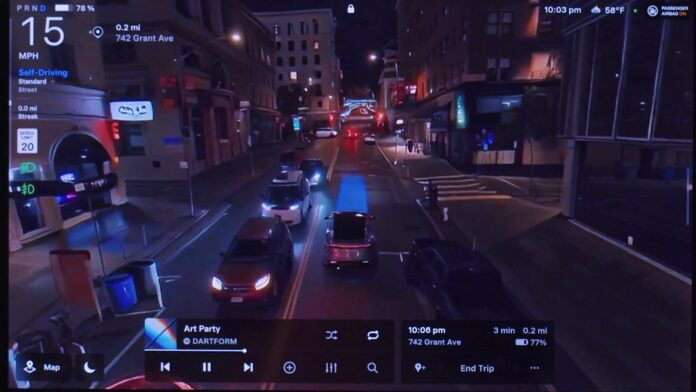

The photoreal street scene on Tesla’s new FSD v15 screen isn’t coming from a video game engine. It’s drawn on the fly by Tesla’s own neural network, on a small slice of the car’s computer, and Elon Musk has now spelled out how it works. Tesla fan and analyst Dillon Loomis kicked off the conversation on X on Saturday, Nov 21 at 7:10 PM ET / 4:10 PM PT (Sunday, Nov 22 at 9:10 AM JST), calling it “next level engineering.” See Dillon Loomis’s post on X.
Ok. What Tesla’s AI and software teams just pulled off is actually absurd. Turns out Tesla is NOT using Unreal Engine for the new Tesla Reality Visualization with FSD V15
— Dillon Loomis (@DillonLoomis) November 22, 2026
Tesla is generating these scenes using the same neural network that drives the car.
Lead image: Tesla Reality View on the center screen during a night drive in San Francisco, a frame from Tesla’s FSD v15 video. Image: Tesla via X.
For a closer look at the “world model” behind the picture, see our companion explainer.
If you caught our first look at FSD v15 and Reality View, you saw the clip: buildings with lit windows, crosswalk stripes, parked cars, all looking like a night drive in a big-budget game. When Tesla’s teaser landed, plenty of people (Teslarati among them) guessed Tesla had licensed Unreal Engine, the software behind games like Fortnite. Fair guess. It turns out to be wrong, and the real answer is stranger.
What Ashok, Elon and Dillon said
It started with a before-and-after. Whole Mars Catalog posted Tesla’s 2020-era wireframe visualization (colored boxes floating on black) next to the new Reality View with the caption “Look how far we’ve come.” Tesla’s VP of AI Software, Ashok Elluswamy, quoted it on Saturday, Nov 21 at 2:57 PM ET / 11:57 AM PT (Sunday, Nov 22 at 4:57 AM JST):
The crazier thing is that the right side uses less compute than what the left used to take.
— Ashok Elluswamy (@aelluswamy) November 21, 2026
Extreme compute efficiency optimization.
Musk piled on a few hours later, at 5:35 PM ET / 2:35 PM PT (7:35 AM JST Sunday):
This is real-time AI video generation (no gaming engine!) using just half of one AI4 TRIP accelerator. Let that sink in …
— Elon Musk (@elonmusk) November 21, 2026
That’s the post Loomis quoted. He did the math: each AI4 computer has two chips for redundancy, each chip has three TRIP cores, so six in total. Half of one is about 8% of the car’s neural horsepower, by his count. In an earlier post, Elluswamy also wrote that “the same end-to-end driving model also renders a realistic view of the world around the vehicle,” and that it’s there to show the car’s intent: arrows for the turns FSD plans to take, pins for where it plans to park. Drive Tesla Canada covered both of his posts. Tesla’s own release notes back up the efficiency point, describing Reality View as “a single end-to-end visualization using less total compute.”
Then, on Sunday at 6:02 AM ET / 3:02 AM PT (8:02 PM JST), replying to a v15 review, Musk went full engineer:
In case anyone is curious:
— Elon Musk (@elonmusk) November 22, 2026
We’ve had a ~pixel-perfect world model since last year, which is critical for synthetic data generation.
The (much) smaller version of that in the car is a conditional mean-flow model, based on the recent sequence of Tesla Universal Vision Encoder features…
The full post goes further. Tesla forks off the same vision features that feed the roughly 3 billion-parameter model that actually drives, then runs a separate model of about 1 billion parameters. It takes the previous Reality View image, adds noise, and cleans it up into the current one. The output is a short video chunk of eight images at 36 frames per second, at the screen’s resolution. Half a TRIP engine does that job, spread over four cycles of the car’s 18-per-second vision updates. Musk admitted the delay is “a bit high” for now, and said Tesla has a way to cut it by roughly 35%. In a follow-up he explained why it’s only half a TRIP: that’s all that was left on the second chip, and the TRIP mostly handles 8-bit integer math, so one common step has to be done the slow way, in 28 steps. “AI5 is a gigantic improvement. Roughly 12X more compute,” he added.
All of those technical details come from Musk’s and Elluswamy’s posts. Tesla hasn’t published a paper or spec sheet on Reality View, so treat the numbers as the company’s own description.
What it all means, in plain English
That was a lot of jargon. Here’s the decoder ring.
- Game engine (Unreal Engine): software that video games use to draw 3D worlds. Artists build models of streets and cars, and the engine renders them. Everyone assumed Tesla did something like that. It didn’t.
- Neural network: a program that learns from examples instead of following hand-written rules. Tesla’s learns from huge amounts of driving video.
- End-to-end model: one network that goes straight from camera images to steering, braking and acceleration, with no separate hand-coded steps in between. Reality View hangs off that same system.
- Vision encoder (Tesla’s “Universal Vision Encoder”): the part that looks at the camera feeds and boils them down into compact notes about the scene. Think of it as the car’s eyes plus a very fast note-taker. Tesla’s release notes say the same encoder is shared by FSD, Robotaxi and the Optimus robot.
- Generative video and “diffusion”: a way of making pictures by starting from static, like TV snow, and cleaning it up step by step until a clear image appears. Tesla’s in-car version starts from the last frame instead of pure static, which saves a lot of work. “Mean-flow” is a shortcut technique that gets there in fewer steps.
- “1B” and “3B”: billions of parameters, the internal dials a network tunes as it learns. More dials usually means more capable, but also more computing work.
- World model: a network that can imagine realistic driving scenes. Musk says Tesla’s big one in the data center is “~pixel-perfect” and is used to create practice scenarios for training (“synthetic data”). The car runs a much smaller cousin.
- AI4 (HW4), SoC and TRIP: AI4 is the self-driving computer in newer Teslas. It has two main chips (SoCs, or systems on a chip), and each has three TRIP cores, Tesla’s name for the circuits that do neural-network math. One chip can take over if the other fails.
- SRAM: very fast memory built into the chip. Musk says moving a small piece of the system into it used up compute, leaving only half a TRIP for Reality View.
- 8-bit integers and “softmax in 28 steps”: the chip is built for simple, low-precision whole-number math, which is fast and frugal. One common calculation (softmax) has no built-in shortcut, so the chip grinds through it in 28 steps. It’s like doing long division by hand because your calculator lacks a button for it.
- 36 fps and 18 Hz: the car’s vision updates 18 times a second, and the screen plays the generated clips at 36 frames per second, smoother than most TV.
- Latency: the delay between what the cameras see and what the screen shows. Musk says it’s a bit high right now, so the picture can trail reality slightly.
- AI5: Tesla’s next self-driving computer. Musk claims roughly 12 times the compute of AI4.
The short version: the old screen showed boxes and lines that engineers coded to represent what the car detected. The new screen is the car’s own “imagination” of the scene, built from the same notes it uses to drive. That’s why Elluswamy keeps stressing intent. When the screen shows an arrow over a turn or a pin in a parking space, it’s telling you what the driving system itself is planning, in a picture anyone can read.
And the efficiency is the part engineers are gawking at. Generating video usually takes serious hardware. Doing it live, inside a car, on roughly a twelfth of a computer that’s also busy driving, is unusual. Loomis’s own follow-up adds a fair caveat: early reviews are so focused on the graphics that there’s still little detail on whether v15 fixed v14’s routing and speed-selection gripes.
After we moved our tiny decoder into SRAM, we only have half a TRIP out of three on SoC B, for this reality visualizer, so spent the compute as best we could. TRIP basically only handles 8-bit int and has to run softmax in emulation mode in 28 steps.
— Elon Musk (@elonmusk) November 22, 2026
AI5 is a gigantic improvement. Roughly 12X more compute.
Who gets it
Reality View is part of FSD v15, which began reaching a first wave of owners on Nov 21, with a wider release expected in December. Tesla hasn’t listed which cars get it. Drive Tesla Canada expects it to be limited to HW4 cars with the newer AMD Ryzen infotainment computer, which is an expectation, not a Tesla statement. Musk’s AI5 comment hints that the next computer will have plenty of room to make the picture sharper and faster.
The EVX Take
This is the most interesting part of v15, and it isn’t the graphics. A screen generated by the driving system is a window into what that system believes, which is exactly what a supervising driver, or a regulator, wants to see. That’s relevant in Japan, where FSD (Supervised) still isn’t approved and transport officials care a great deal about how a driver understands an assistance system’s intent. It also sets a high bar for Toyota’s work with Waymo and Nissan’s with Wayve: their screens will be compared with this one. And there’s a small irony for the country that gave the world so many game consoles. The best-looking car graphics of 2026 skipped the game engine entirely.
Follow @teslaloha on X for more

