
Huawei’s partner brand Stelato has started testing Level 3 automated driving at 120 km/h (75 mph) on expressways between Chinese cities, with the V8 minivan that goes on sale this Friday. Stelato (享界), the brand BAIC builds with Huawei, announced on Tuesday, Nov. 17 that the V8 had begun what it calls China’s first cross-city L3 expressway road test at that speed, and the first cross-city L3 test for an MPV.
The announcement went up on Stelato’s official Weibo account at 9:30 AM Beijing time on Tuesday (10:30 AM JST; 8:30 PM ET / 5:30 PM PT on Monday, Nov. 16). Huawei executive director Richard Yu (Yu Chengdong), the public face of Huawei’s HIMA car alliance, shared it and said he hoped the technology would make long-distance travel easier for ordinary people.
To be clear about what this is: a company road test, not a feature owners can switch on. Under China’s rules, L3 on public roads still needs specific approval, and buyers will only get to use it once regulators allow it.
What the car is testing
The test uses the V8’s top Ultra and Ultra+ versions. They run Huawei’s Qiankun ADS 5 driving system with 38 sensors in total, including an 896-line “dual optical path” lidar, part of a four-lidar setup according to IT之家 (IT Home). Stelato says the car was designed around an L3 architecture with redundancy in eight areas: perception, computing, braking, steering, power supply, communications, positioning and the driver interface. The idea is that if one part fails, a backup keeps the car under control until a human takes over.
On the road, the system can be activated on expressway sections at up to 120 km/h, which is China’s top legal expressway speed. It handles navigation lane changes, lane changes to pass slower traffic, and lane changes for safety. It can also move over early or slow down for merging traffic at on-ramps, and it handles the interchange ramps that connect one expressway to another. Stelato says it works in light to moderate rain, in snow and at night.
Before taking the car onto public roads, the company ran large numbers of simulations plus closed-course tests of typical problem cases, such as a stopped car blocking the lane, a slow car ahead and a car braking hard in front, Phoenix New Media (凤凰网) reported. Stelato hasn’t said which cities the route links or how many cars are involved.
Where China’s L3 rules stand
China has been building the legal path one piece at a time. The first two L3 market-access pilots, from Changan and BAIC, received conditional approval in December 2025, with their L3 functions limited to designated road sections and conditions, as we noted in our report on China’s driver-assist fleet. In 2026 the Ministry of Industry and Information Technology and the Ministry of Public Security have pushed approvals for production cars with L3 and set expressways and urban expressways as the legal places to use it. A national traffic standard for L3, GA/T 2388-2026, took effect in July and covers L3 testing and demonstration use, according to Gasgoo and IT之家. Stelato says the V8’s cross-city test runs under that framework.
The jump that matters here is the move from one city to many. Testing between cities means dealing with different local conditions on the same trip, and that’s the kind of trip a family minivan actually makes.
The V8 itself launches on Friday, Nov. 20. Presale prices start at 329,800 yuan (about $48,900). It joins the S9, S9T and G9 in the Stelato lineup.
How it compares with Tesla
The difference with Tesla comes down to who is responsible. Tesla’s FSD (Supervised) can already drive point to point on highways and city streets, but it’s a Level 2 system. The driver has to watch the road the entire time and is legally in charge. An L3 system, once approved, lets the driver look away under defined conditions, and responsibility shifts toward the carmaker while the system is in control. Tesla has gone for software that works almost everywhere under supervision. Huawei and its partners are chasing legal sign-off for hands-off driving in narrower conditions, backed by lidar and redundant hardware. Both approaches are converging on the same goal from opposite directions.
The EVX Take
Japan was actually first here. In March 2021, Honda launched the Legend Hybrid EX with Honda Sensing Elite, whose Traffic Jam Pilot was the first system to win Level 3 type designation from Japan’s transport ministry, according to Honda’s release. But it worked only in expressway traffic jams, and Honda built just 100 of them. Five years later, Chinese brands are testing L3 at full expressway speed between cities in a family minivan that starts at about ¥7.8 million (about $48,900) at Chinese prices. For Toyota, Honda and Nissan, the worry isn’t one Huawei-powered MPV. It’s that China is writing the practical rulebook for L3 (the speeds, roads and redundancy requirements) while Japan’s own L3 story has barely moved past traffic jams. Whoever gets real-world L3 approval at expressway speed first will set the standard others are measured against, and Japanese suppliers of lidar, chips and braking systems will want to be on that list.
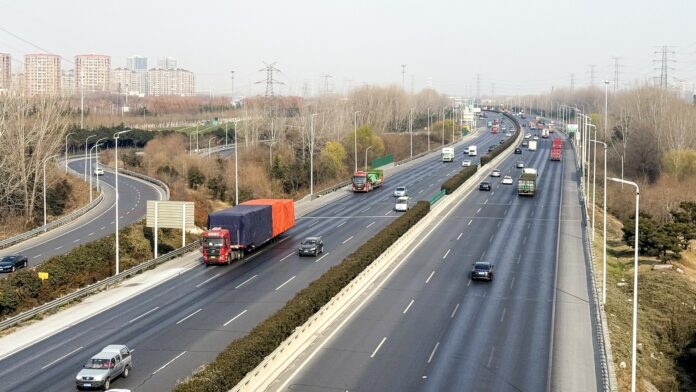
Sources: Stelato (享界汽车) official Weibo; Honda release; IT之家; Phoenix New Media (凤凰网); Gasgoo. Featured image: traffic on China’s G4 Beijing–Hong Kong–Macau Expressway near Exit 662. Photo: Windmemories via Wikimedia Commons, CC BY-SA 4.0 (cropped).

