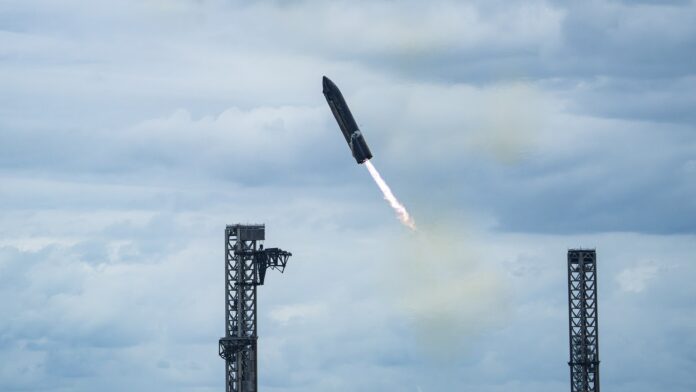


SpaceX caught a Starship. Not the booster this time, the ship itself: Ship 42 came home from 14 laps around Earth and settled into the arms of the launch tower at Starbase, Texas, on Saturday, Nov. 14 at about 4:20 p.m. ET / 1:20 p.m. PT (6:20 a.m. JST Sunday, Nov. 15). Yes, 4:20. Somebody at SpaceX has a sense of humor, or the universe does.
It’s the first time the upper stage of an orbital rocket has flown back from space and been grabbed by the tower it launched from. SpaceX’s own Flight 15 recap says the ship returned to “the same launch site it had just left 22.5 hours prior,” and the company’s verdict was not exactly modest: Starship “changed everything.”
A full day in orbit, then home for dinner
Flight 15 lifted off from Pad 2 at Starbase on Friday, Nov. 13 at 5:47 p.m. ET / 2:47 p.m. PT (7:47 a.m. JST Saturday, Nov. 14), per Spaceflight Now. The ship relit one Raptor to slip into an orbit of about 275 km, then spent roughly 42 minutes deploying 26 Starlink V3 satellites. SpaceX says it made contact with every one of them and they’re already raising their orbits. Starlink says that single payload adds up to 26 terabits per second of capacity to the network.
Then the ship just hung out. SpaceX had early bail-out options to splash down off Hawaii or Chile, and it didn’t need any of them. After more than 20 hours of system checks, a single sea-level Raptor fired for the deorbit burn. Starship reentered over the Pacific, crossed Mexico and South Texas, swung out over the Gulf, lit three engines for the landing flip and dropped between the tower’s “chopsticks.” SpaceX’s flight timeline puts the catch at 22 hours, 32 minutes and 34 seconds after liftoff.
“That was the Holy Grail of space flight, plummeting through fire to be snatched out of the air by steel,” SpaceX host Dan Huot said on the webcast, as quoted by the BBC. “We caught a Starship and now everything changes.”
The booster had a rougher Friday
This was supposed to be the first double catch, booster and ship, which we previewed when SpaceX set the date. Super Heavy Booster 22 didn’t make it. SpaceX says its boostback burn ended early on low fuel, its guidance software called an automatic abort, and it diverted to an offshore landing burn over the Gulf, where the flight termination system fired. The root cause is still under investigation.
Elon Musk’s short version: “Booster was slightly low on fuel.” His longer version blamed “slight underperformance of engines on this flight.” The fixes he listed are better and more consistent engine performance with Raptor V3.2, plus a flight-software tweak to cut the first main-engine shutdown about one second earlier. He also said “this booster loss does not change our timeline” to high-volume, fully reusable flights, and that the next booster is “almost ready for flight.” Losing the tower would have been the real setback, he noted, at a cost of maybe two to three months. Diverting the booster kept the tower safe for the ship a day later.
SpaceX has caught Super Heavy boosters three times before. Catching the ship is a different animal: it has to survive reentry from orbital speed first, then flip upright and slow itself into the arms. Drive Tesla Canada notes this was only the second time Starship has reached orbit at all.
The EVX Take
Rockets get cheap when you stop throwing them away, and until Saturday nobody had flown an upper stage back from orbit and caught it at the pad. Japan’s flagship H3 still discards both of its stages on every flight. Japan’s most advanced reusable-rocket test so far was Honda’s experimental rocket in Taiki, Hokkaido, which climbed to 271.4 meters and landed within 37 cm of its target in June 2025, with suborbital flight the goal for 2029. That gap is wide. For people in Japan the nearer payoff is bandwidth: every Starship that flies full of V3 satellites adds capacity to the network that already backs Starlink service and KDDI’s satellite-to-phone texting here, and a ship that comes back to fly again makes those launches cheaper. The next things to watch are a clean booster catch with Raptor V3.2 and how quickly Ship 42, or one like it, flies again.
Lester’s take
Let me get this straight. SpaceX can drop a skyscraper-sized ship out of orbit and catch it with a pair of giant chopsticks, at 4:20 on the dot, and my Model Y in Tokyo still isn’t allowed to use the FSD I paid for. Four Teslas, four FSD purchases. I’m starting to think the rocket gets regulatory approval faster than my car does. Huge congrats to the SpaceX team. Next up, catch them both on the same flight, please. I’ll bring the popcorn.
Sources: SpaceX, SpaceX on X, Elon Musk on X, Spaceflight Now, BBC, Drive Tesla Canada, Honda. Featured image: SpaceX photo of Ship 42 on final approach to the Starbase tower (cropped).