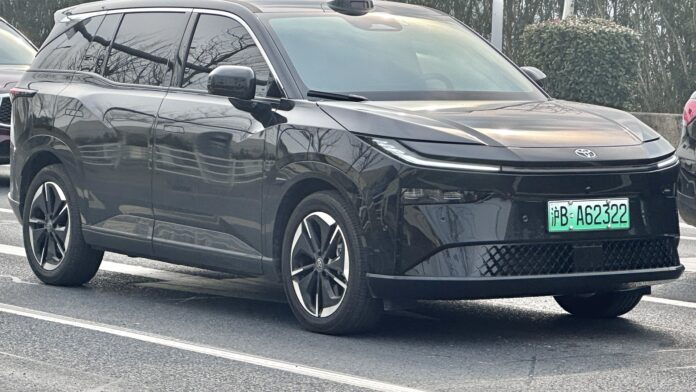

Toyota’s joint venture GAC Toyota is recalling 121,260 bZ3X and bZ7 electric cars in China, according to filings published Nov. 4 by China’s State Administration for Market Regulation (SAMR). The bZ3X recall alone covers 100,175 SUVs over front suspension nuts that can work loose. The other two campaigns, on the bZ7 sedan, are about software.
On the same day, Toyota’s other Chinese venture and its China import arm also recalled 55,477 Land Cruiser Prado and Lexus GX 550h hybrids over a fuel-line connector. That brings Toyota’s China total for the day to 176,737 vehicles, as CarNewsChina tallied.
Three EV recalls, three different problems
The details come straight from SAMR’s notice, and were carried in full by Jiemian, Beijing Business Today via Sina Finance and Yiche:
- bZ3X, 100,175 vehicles built Feb. 27, 2025 to March 26, 2026 (filing S2026M0124V). The nuts that hold the front stabilizer bar links weren’t designed with enough clamping force. They can loosen and make noise, and in extreme cases fall out, which could affect stability. Dealers will fit improved nuts for free.
- bZ7, 18,130 vehicles built Oct. 28, 2025 to Aug. 3, 2026 (S2026M0125V). With the Comfort Stop feature switched on, braking force can be limited at low speed under certain conditions, so the car takes longer to stop. Fix: a free software update.
- bZ7, 2,955 vehicles built March 10 to May 15, 2026 (S2026M0126V). An over-the-air update to the front recognition camera can go wrong, and with Integrated Cruise Assist on, the steering wheel may turn unexpectedly. Fix: another free software update.
GAC Toyota says it will contact owners through its app and by phone.
That’s the biggest recall of Toyota’s China-built EV lineup since it launched, by AutoCN’s count, and it lands on the model that has carried the brand’s Chinese EV push. The bZ3X went on sale in March 2025 as a car developed in China with GAC, part of Toyota’s move toward locally led EV development. It quickly became one of China’s best-selling joint-venture EVs. The bZ7 sedan followed, built on the same local playbook. In July, about 24,000 bZ7s were already recalled over software faults in a Bluetooth module and the thermal management controller, CarNewsChina noted.
And the Prado
The fourth campaign isn’t an EV, but it’s the one SAMR started itself. After a defect investigation by the regulator, FAW Toyota (Chengdu) is recalling 47,347 China-built Land Cruiser Prado hybrids made July 15, 2024 to Oct. 6, 2026, and Toyota Motor (China) Investment is recalling 8,130 imported Lexus GX 550h hybrids, according to a second SAMR notice also reported by IT Home. External force can lift the fuel-line quick-connector retainer, and an impact could then detach the line and leak fuel. Dealers will inspect the connectors, add a protective cover plate and replace the fuel line where needed.
The EVX Take
The interesting part for Japan is the split. Two of the three EV fixes are pure software, and one of them exists because an over-the-air update misbehaved. That’s what building cars the Chinese way looks like: faster development, features shipped by OTA, and recalls fixed the same way. Toyota made the bZ3X its template for that approach, and Nikkei xTECH has reported that the car leans heavily on Chinese suppliers rather than Toyota’s traditional Japanese keiretsu. Japanese buyers can’t get the bZ3X or bZ7. But Toyota is betting on more software-led EVs everywhere, including the multi-pathway platform it is developing, so how quickly and cleanly these China fixes roll out is worth watching from Tokyo. It’s also a reminder of how tough China’s market has become for Japanese brands: NEV retail fell 10% in October even as the plug-in share hit a record, and the bZ3X is one of the few Japanese-badged EVs holding its own there.
Sources: SAMR, GAC Toyota recall notice (Nov. 4, 2026); SAMR, FAW Toyota (Chengdu) and Toyota Motor (China) recall notice; Jiemian; Beijing Business Today via Sina Finance; Yiche; IT Home; AutoCN; CarNewsChina; Nikkei xTECH.
— The EVX News team
Featured image: a black Toyota bZ3X with Chinese green NEV plates, Feb. 1, 2026. Photo: JustAnotherCarDesigner / Wikimedia Commons (CC0, cropped and resized).

