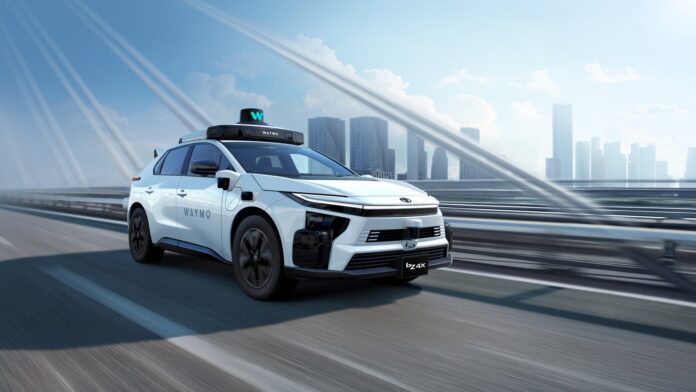

Waymo has picked its car for Japan, and it’s a Toyota. The two companies said on Friday that a fleet of driverless Toyota bZ4X crossovers, built and fitted with Waymo’s self-driving hardware at Toyota’s Takaoka plant in Toyota City, will start testing and validation in Japan in 2027. The United Kingdom and other Waymo markets come after that.
Toyota and Waymo announced the deal in Tokyo at 4:00 PM JST on Friday, Oct. 30 (3:00 AM ET / 12:00 AM PT), and held a joint briefing the same day. It’s the first concrete step since the two signed a preliminary agreement in April 2025 that named no car and no schedule.
What Toyota and Waymo actually announced
According to Toyota’s release and the matching post on Waymo’s blog, the cars will be built “under one roof” at Takaoka, from assembling the base bZ4X to installing Waymo’s sensors and computers. That’s different from how Waymo has usually worked. Its Jaguar I-Pace robotaxis were finished cars that Waymo fitted out after delivery.
The robotaxi bZ4X is a taxi-spec version of Toyota’s electric SUV, with more rear legroom, automatic doors, a power liftgate and ambient lighting. It’s designed for SAE Level 4, where the system does all the driving within a defined area and conditions. At the briefing, Toyota executive vice president Hiroki Nakajima said the bZ4X has far more rear-seat space and luggage room than the JPN Taxi, the boxy Toyota that now dominates Tokyo taxi ranks, Reuters reported in Japanese.
Plenty is still missing. Neither company gave a fleet size or a Japanese city. Nakajima said the first operations would use a small number of vehicles, and Waymo co-CEO Dmitri Dolgov declined to name places or numbers, saying only that more would be shared as the companies work toward commercialization, Nikkei reported. Reuters’ Japanese report said the early phase would include public riders, starting with a small group and growing from there.
Dolgov explained why Japan goes first. “We’ll start with the right-hand drive markets in Japan and the UK,” he said, according to Reuters, adding that there were no other countries or timelines to share yet. Nakajima noted that Toyota also builds left-hand-drive bZ4Xs and wants experience in Japan before going wider.
In the release, Dolgov said Waymo chose Toyota “because of our respect for the legendary safety, reliability, and quality of their vehicles,” and repeated Waymo’s own claim that it is up to 20 times safer than human drivers for serious-injury crashes in the areas it serves. Nakajima’s line was more Toyota: “No single company can achieve the goal of zero traffic accidents alone.”
How this fits Waymo’s Tokyo plan
This isn’t Waymo’s only Japan project, and the two shouldn’t be confused. In September, Waymo, taxi app GO and Nihon Kotsu said they aim to start Japan’s first fully driverless commercial taxi service in Tokyo during 2027, scaling in stages to about 100 vehicles, bookable through both the GO and Waymo apps. That service has been testing in seven Tokyo wards since 2025 with trained Nihon Kotsu drivers behind the wheel, and its launch date depends on permits under the Road Traffic Act and the Road Transport Act.
Those Tokyo test cars are Jaguar I-Paces. Dolgov said Waymo still plans its 2027 I-Pace pilot, and Reuters reported that the Tokyo service intends to add other models over time. Neither company has said the Takaoka-built bZ4X will join the GO and Nihon Kotsu fleet, though it’s the obvious candidate. For now, they’re two 2027 timelines running side by side.
Japan’s rules already allow this kind of service. Level 4 driving on public roads has been legal since the revised Road Traffic Act took effect in April 2023, Nikkei noted, and real deployments are slowly showing up. Japan Airlines started Level 4 driverless cargo tugs at Fukuoka Airport this month. A robotaxi in downtown traffic is a much bigger test than an airport apron, though.
Toyota and Waymo will also keep looking at Waymo technology for privately owned Toyotas, and will work with Woven by Toyota on how Waymo’s driving data could improve road safety more broadly. That sits next to Toyota’s in-house plan for an end-to-end Level 2++ system on its Arene platform from 2028, so Toyota is now running two very different autonomy tracks at once.
EVX take
For Japan, the factory matters more than the headline. Toyota gives Waymo the most credible way into the Japanese market, with Japanese-built vehicles, a Japanese brand on the hood, and a manufacturing partner that regulators and taxi operators already trust. In return, Toyota gets real Level 4 deployment experience in its home market without having to build the driver itself first. Taxi operators should pay attention to the JPN Taxi comparison, because Toyota just proposed the vehicle that replaces its own taxi. Tesla is the useful contrast. It builds its own driverless car, the Cybercab, and its Robotaxi service now runs until 2 AM in the U.S., while Japanese owners are still waiting for FSD (Supervised) approval. The first company to give driverless rides to paying customers in Japan will have a big say in what rules come next.
Next up is the boring part that decides everything: which city, how many cars, and when the permits arrive. Waymo and its partners say those answers come as commercialization gets closer.
Sources: Toyota Global Newsroom (EN), Toyota Global Newsroom (JP), Waymo blog, Waymo on X, GO press release (Sept. 15), Reuters via CNA, Reuters Japan, Nikkei, Drive Tesla.
— The EVX News team
Featured image: The Toyota bZ4X autonomous vehicle for Waymo’s ride-hailing service. Photo: Toyota Motor Corporation (press image).

