

The bulldozers got there before the press release. Drone footage shot Sunday over Tesla’s proposed “Project Crystal Sun” site in Fort Bend County, southwest of Houston, shows big cleared areas, equipment staging yards and crews leveling a large stretch of the roughly 3,000-acre property. This is where Tesla wants to build a $10.1 billion factory that turns silicon ingots into finished solar panels. Tesla hasn’t announced a groundbreaking. Elon Musk did the next best thing. On Monday, Nov. 9 at 10:21 a.m. ET / 7:21 a.m. PT (Tuesday, Nov. 10 at 12:21 a.m. JST), he quote-posted the news on X with three words: “Project Crystal Sun.”
The video comes from S.E. Robinson, Jr., who flies Tesla’s Texas sites regularly. He posted a 12-minute flyover at 9:41 a.m. ET / 6:41 a.m. PT Monday (11:41 p.m. JST). His notes: massive clearings, equipment staging areas, the old homestead on the land already in use, and a large area being leveled. “It appears Tesla has decided to build here!” he wrote. Sawyer Merritt shared it as construction officially starting, and that’s the post Musk quoted. Drive Tesla Canada reads the Musk reply as all but confirming the start of construction. Teslarati points out there’s still no formal groundbreaking announcement from Tesla, and TeslaNorth adds a fair caveat: site prep on its own doesn’t prove every approval is signed.
Why some dirt counts as news: three weeks ago the site wasn’t settled. When Fort Bend County commissioners approved four incentive agreements on Oct. 22 (we covered the 4-0 vote), Tesla was still weighing a rival location outside Texas and said it hoped to pick before the end of 2026. As late as Nov. 5, county officials told Spectrum News there was no guarantee Tesla would build at FM 1994 and FM 762 near Needville. Heavy equipment on that exact land, plus a nod from the CEO, is the strongest signal yet that the answer is Fort Bend. The state paperwork isn’t finished. The Texas Comptroller’s JETI application page for Tesla’s Lamar CISD agreement still shows the application stage, with the state’s recommendation posted Aug. 31 and no final agreement listed.
The plant itself is spelled out in Tesla’s filings. It’s vertically integrated: ingot and wafer manufacturing, coating, metallization and printing lines, cell testing and quality control, then finished modules. About $8.6 billion of the total is equipment and $1.5 billion is real property. Construction runs from 2026 through 2028, with commercial operations in the first quarter of 2029. The plan calls for a construction peak of about 1,147 workers, roughly 1,900 jobs in the first year of operations and 9,712 permanent jobs by 2033. An economic analysis attached to the project estimates about $6.4 billion in state and local taxes and roughly $107 billion added to Texas GDP over several decades. Those are application forecasts, not results. Sawyer Merritt’s summary has construction wrapping up in 2028.
The size makes more sense next to Musk’s solar goal. On Tesla’s Q4 2025 call in January he said the company would work toward 100 GW a year of solar cell production, integrated from raw materials to finished panels. Crystal Sun is the first real hole in the ground behind that sentence. It also lands in the same metro as Tesla’s Megafactory in Brookshire, where Megapack 3 production has started, and on the Q3 call Tesla said Megapack supply for 2027 is nearly sold out. Batteries on one side of Houston, the panels that fill them on the other.
The EVX Take
Japan has seen this movie from the other seat. Sharp led world solar-cell production for much of the 2000s, then Japanese makers lost the volume game to China. Tokyo’s comeback plan doesn’t fight on silicon. METI’s next-generation solar strategy from November 2024 bets on thin, flexible perovskite cells, with a target of about 20 GW installed by 2040 and gigawatt-scale production by 2030. The flagship is Sekisui Chemical, which is putting a 100 MW line into buildings at Sharp’s former plant in Sakai, a ¥90 billion (about $570 million) first phase due in 2027 on the way to a 1 GW setup costing about ¥315 billion (about $2 billion), with half of that covered by subsidies, according to the company’s investor materials. Tesla is going the opposite way, with plain silicon at enormous scale and the whole chain under one roof. Musk’s 100 GW-a-year talk is five times Japan’s entire 2040 perovskite target, every year. Fort Bend panels are aimed at U.S. projects, so nobody in Japan should expect Texas modules on the roof soon. The thing to watch is whether a Western maker can do ingot-to-module cheaply outside China. If Tesla pulls it off, that’s a template Japanese makers and their equipment suppliers will study closely.
Lester’s take
I bought FSD on four different Teslas and then moved to a country where I can’t use it, so I’m basically a professional at believing in “construction from 2026 to 2028.” This one at least comes with bulldozers. Also, can we talk about the name? “Project Crystal Sun” sounds like the finishing move in a Saturday morning anime. Elon typed three words, and somehow that’s still the most official statement anyone has made. I’ll keep watching from Tokyo, where my Model Y Juniper is still waiting on its own approval.
Sources: Elon Musk on X, S.E. Robinson, Jr. on X, Sawyer Merritt on X, Texas Comptroller JETI application J0050, Drive Tesla Canada, Teslarati, TeslaNorth, Spectrum News, METI, Sekisui Chemical.
— Lester Miyashiro, EVX News
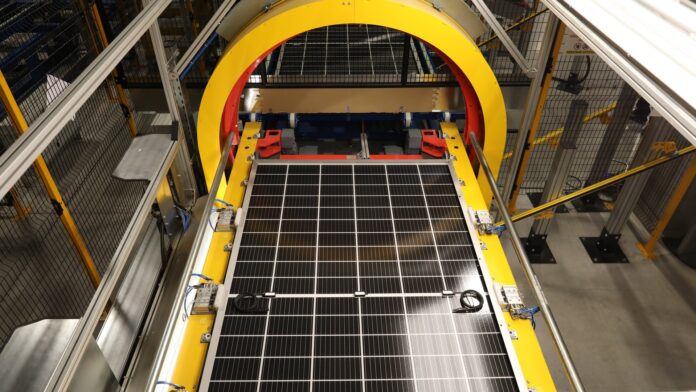
Featured image: A heterojunction solar module on the production line at 3Sun’s gigafactory in Catania, Italy (not a Tesla plant), Feb. 2025. Photo: Ottaluc via Wikimedia Commons, CC BY-SA 4.0 (cropped).